Abbesses

Abbesses

abbess.jpg

Whatever the restrictions on female monasticism were at any particular time, the actual lifestyle of a particular convent was determined to a large extent by the abbess. In many instances, she had as much power as her male counterpart. Despite the church’s best efforts to put tight reins on nunneries, the abbess often ruled her community according to her own prescribed standards. This was possible because ‘monasticism from its very beginning… lay outside the established order of the Church.’ It was this factor, more than any other that allowed women a meaningful place in the religious life of the Middle Ages. Susan Bell maintains that ‘nuns could and did achieve complete equality with men in the Middle Ages, particularly between the 6th and 12th centuries.’

Whether there was actual complete equality between the sexes in monasticism is a matter for debate but certainly monasticism offered women a place of prominence that could not be found elsewhere in the Church. Indeed, in rare instances, abbesses wielded power comparable to that of the local bishop. Lioba’s mentor, Mother Tetta, for example was said to be ‘so powerful in her ability to lead her community that no man dared enter into her monastery; even bishops were forbidden.’ The power of the abbess was reinforced by the religious symbolism that was and is so pervasive in Catholicism. ‘Like the bishops and abbots, they wore the mitre and cross and carried the staff.’ During the installation service of the abbess of St. Cecilia in Cologne, ‘each member of the clergy under her jurisdiction passed before her, prostrating himself, and kissing her hand.’ The abbess of Las Huelgas in Spain served as ‘dame, superior, prelate, legitimate administrator, spiritual and temporal,’ not only of her own monastery but also of the ‘convents, churches, and hermitages’ under her jurisdiction. Even if she did not wield ecclesiastical power, it was common for the head of the convent to act as a business administrator with wide ranging duties closely tied to the local economy and politics. This is illustrated in Chaucer’s Tales. Here, the prioress is a ‘woman of proud breeding, and large responsibilities administering a spacious domain as the source of her convent’s revenues.’

The position of abbess was the highest to which a woman could attain. It was clearly above that of prioress — women who also ruled convents but were subject to an abbot. The abbess not only ruled a large community of nuns (and frequently monks as well), but also had jurisdiction over vast territories that included villages and towns. And this jurisdiction in a number of instances did not involve merely civil matters. According to Joan Morris, ‘the abbess of a religious order was an ordained person even though those who were under her were not so’, and ‘they were exempt from jurisdiction of a bishop and directly dependent on the Holy See.’ Morris argues in her book, The Lady Was A Bishop, that the long history of women with clerical ordination has been purposely hidden in an effort to hold women back.

- Daughters of the Church: Women and ministry from New Testament times to the present, by Ruth A. Tucker and Walter L. Liefield, Zondervan 1987 pp 143-145

Thomas Aquinas and Women's Ordination by Therese Koturbash

Blockbuster theologian, saint and Doctor of the Roman Catholic Church, Thomas Aquinas (1225-1274) is important to the case for women's ordination.

Historically, there are three 'reasons' for exclusion of women from priesthood:

Thomas Aquinas (1225-1274) … important to know in the case for women’s ordination

Thomas Aquinas (1225-1274) … important to know in the case for women’s ordination

  1. women were considered to be the source of sin (Eve);

  2. women were considered to be unclean at certain times (menstruation, child birth);

  3. women were considered inferior to men in every way. Sidebar: Until fairly recently, even scientists held the view that women were inferior to men!

This Is Where Thomas Comes In

This is where Thomas comes in.

Thomas Aquinas was the most influential Catholic theologian of the Middle Ages. An Italian Dominican philosopher and theologian, he was a prolific writer who combined theological principles of faith with the philosophical principles of reason. He is considered an authority of the Roman Catholic Church.

During his time, women were excluded from priestly ministry. Thomas’s nature compelled him to find a justification for this. He determined that the main reason was women’s inferior nature. He based his findings on what he read in Aristotle's work which was was well known and popular in Europe at the time.

Like Aristotle, Thomas believed that only the male seed carried life. Following this assessment, he then judged that women have less intelligence than men and are weaker in character. than men.

Thomas And Women:

This caused Thomas to rationalise things like this:

In the 17th century, many researchers believed each spermatozoa contained a tiny, completely pre-formed human within it, as illustrated in this 1695 sketch by Nicolaas Hartsoeker. (Wikimedia Commons)

In the 17th century, many researchers believed each spermatozoa contained a tiny, completely pre-formed human within it, as illustrated in this 1695 sketch by Nicolaas Hartsoeker. (Wikimedia Commons)

We want to note that Women’s Ordination Worldwide has tremendous respect for Thomas Aquinas and his scholarship. However, had he the benefit of modern science, it is unlikely he would have arrived at the conclusions about women and justifications for their exclusion from priesthood that he did.

WOW is indebted to the work of Dr. John Wijngaards, Wijngaards Institute for Catholic Research and their website, womenpriests.org. For their page on Thomas, see here: Thomas Aquinas

This page prepared for WOW by
Therese Koturbash: Therese Koturbash, BA, LLB, GDCL served as Canadian Delegate to Women’s Ordination Worldwide from 2008 to 2013. For all five of those years, she was elected member of WOW's four person International Leadership Circle. She has also been the National Coordinator of Canada's Catholic Network for Women's Equality. Today, Therese serves on WOW’s Communications Team and is a volunteer with WOW member group, Wijngaards Institute for Catholic Research. Her paid work is as a family attorney.

Notes:

  1. Poppick, Laura, The Long, Winding Tale of Sperm Science …and why it’s finally headed in the right direction, Smithsonian Magazine, June 7, 2017.

Rev. Florence Li Tim-Oi -- First Woman Ordained in Anglican Communion 25 January 1944

Reverend Florence Li Tim-Oi

Reverend Florence Li Tim-Oi

Florence Li Tim-Oi (5 May 1907 – 26 February 1992) was the first woman to be ordained to the priesthood in the Anglican Communion. This happened on 25 January 1944 in Macau.

When the Church of England began ordaining women priests in March 1994, few people appreciated that the first Anglican woman priest in the Anglican Communion had been ordained 50 years earlier on January 25, 1944 when Florence Li Tim Oi’s priesthood was recognised by Bishop Ronald Hall in war torn Macao.  Her story bears remarkable similarity to that of Roman Catholic Ludmila Javorova who was clandestinely ordained in Soviet occupied Czechoslovakia’s underground Church by Bishop Felix Davidek in 1970.

Li Tim-Oi was born in the fishing village of Aberbeen, Hong Kong during a time when baby boys were preferred. Her parents, forward looking people, were determined to challenge prejudice against girls. Their chosen name for their child means much beloved daughter.

As a young student, Li Tim-Oi joined the Anglican Church. She chose the name Florence at her baptism after Florence Nightingale, the famous 19th century English nurse who she knew as the Lady of the Lamp.

Li Tim-Oi, her mother, Bishop Mok, her father, Archdeacon Lee Kow Yan after her ordination as Deacon by at St John’s Cathedral Hong Kong, Ascension Day 22 May 1941

Li Tim-Oi, her mother, Bishop Mok, her father, Archdeacon Lee Kow Yan after her ordination as Deacon by at St John’s Cathedral Hong Kong, Ascension Day 22 May 1941

Tim-Oi began studies at Union Theological College in Canton. When she attended the ordination of a woman deacon, the presiding Chinese minister asked, ‘Here is an Englishwoman who is offering herself to serve the Church. Might there also be a Chinese woman who feels called by God to serve as a deacon?’ Tim-Oi prayed and asked, 'God would you like to send me?'

Her prayer was answered. She was ordained a deacon on Ascension Day 1941. She was given charge of an Anglican congregation in the Portuguese colony of Macao which at the time was overflowing with refugees from war-torn China.  Though she was not authorized to celebrate the Eucharist (a priest had to travel from Hong Kong for this) Tim-Oi ministered on a full time basis. She tended to the physical and spiritual needs of her congregation and its neighbors.  She baptized, married and buried faithful.  She gave counsel and friendship to the grieving, organised food for the hungry and kept hope and faith alive among the people desperately struggling during time of war.

Hong Kong Bishop Raymond Hall approached his assignments with a sense of practicality. The Japanese occupation of Hong Kong and of parts of China and World War II made it impossible for Anglican priests to get to neutral Macau. When a priest could no longer travel to Macau to preside at periodic celebrations of the eucharist, Hall asked Tim-Oi to meet him in unoccupied territory in Free China where on 25 January 1944 he ordained her a priest. [1] He knew this was a momentous and controversial step. He knew there would eventually be resistance to her service as a priest. In his mind, he resolved that he was not ordaining Florence Li Tim-Oi but instead merely confirming what he and many others witnessed - that Tim-Oi had the gift of priestly ministry and that she was already ordained by God for this service.  In a letter to the Archbishop of Canterbury, William Temple, Hall explained the extraordinary act he was about to do:

I have three Chinese priests in Hong Kong but they cannot now get permission to go to Macao. Her work has been remarkably successful.  My judgment is that it is only exceptional women who can do this kind of work.  But we are going to have such exceptional women in China and such exceptional need.  Moreover, working as a minister in charge of a congregation, Deaconess Li has developed as a man-pastor develops and has none of that frustrated fussiness that is noticeable in women who having the pastoral charisma are denied full exercise in the ministry of the church. 

Hall continued, ‘I'm not an advocate for the ordination of women. I am, however, determined that no prejudices should prevent the congregations committed to my care having the sacraments of the Church.’ [2] After the war, controversy erupted over her priestly ordination. A woman priest? Tim-Oi was asked to relinquish her priest's license. Concerned for the difficulties her status might cause Bishop Hall, and because she viewed his position to be more more important than her own, she agreed to surrender her license. [3] While she ceased functioning as a priest, she never renounced her Holy Orders. She continued to serve another congregation, this time in Hepu, until the rise of Communism.

Reverend Florence Li Tim-Oi

Reverend Florence Li Tim-Oi

Under Maoist persecution, churches in China were closed. The knowledge of her priesthood carried her through Maoist persecution. The Red Guards made her cut up her vestments with scissors and humiliated her in other ways. She was sent for ‘re-education.’ Along with other victims of China’s Cultural Revolution, she lived in obscurity and hardship for more than 30 years. She entered what she says was a very dark period of her life. She contemplated suicide. Then, she says, she was ‘touched by the Holy Spirit.’ She heard God speak to her and say, ‘Are you a wise woman? You are a priest!’ She knew then that God was with her and would support her always, through all of her adversity. She was sent to work on a farm where part of her assignment was to care for chickens. Her home was raided several times and her possessions taken away. Many years later, she was asked how she sustained her faith during this time, and she answered, ‘I just went up the mountain and nobody knew.’ Eventually she was able to retire from the farm. When the curtain eventually lifted, she was granted permission near the end of her life to leave China.

In 1983, arrangements were made for her to come to Canada where she was appointed as an honorary assistant at St. John's Chinese congregation and St. Matthew's parish in Toronto. The Anglican Church of Canada had by this time approved the ordination of women to the priesthood. In 1984 -- the 40th anniversary of her ordination-- Florence Li Tim-Oi was with great joy and thanksgiving reinstated as a priest. This event was celebrated not only in Canada but also at Westminster Abbey and at Sheffield in England even though the Church of England had not yet approved the ordination of women.

From that date until her death in 1992, she exercised her priesthood with faithfulness and quiet dignity.  She won tremendous respect for herself and increasing support for other women seeking ordination. She was awarded Doctorates of Divinity by General Theological Seminary, New York, and Trinity College, Toronto.

The very quality of Ms. Li's ministry in China and in Canada and the grace with which she exercised her priesthood helped convince many people through the communion and beyond that the Holy Spirit was certainly working in and through women priests. Her contribution to the church far exceeded the expectations of those involved in her ordination in 1944. She continued to serve at the Anglican Cathedral in Toronto for several years before her death in 1992.

She died on 26 February 1992 in Toronto and is buried there.

In 2003, the Episcopal Church fixed 24 January as her feast day in Lesser Feasts and Fasts, based on the eve of the anniversary of her ordination. In 2007, the Anglican Communion celebrated the centennial of her birth. [4] In 2018, she was made a permanent part of the Episcopal Church’s calendar of saints. [5] She is memorialized in the calendar of the Anglican Church of Canada with a feast day on February 26. Her archives are held in the Lusi Wong Library at Renison University College, the Anglican college at the University of Waterloo.

The Li Tim-Oi Foundation has now been set up in her memory and is a charity helping women in the Two-Thirds World train for ministry in their own countries.

- Therese Koturbash
Therese Koturbash, BA, LLB, GDCL served as Canadian Delegate to Women’s Ordination Worldwide from 2008 to 2013. For all five of those years, she was elected member of WOW's four person International Leadership Circle. She has also been the National Coordinator of Canada's Catholic Network for Women's Equality. Today, Therese serves on WOW’s Communications Team and is a volunteer with WOW member group, Wijngaards Institute for Catholic Research. Her paid work is as a family attorney.

Notes:

  1. Li, Florence Tim Oi (1996). Raindrops of my Life. Toronto: Anglican Book Centre. pp. 20–21.

  2. Rose, Mavis (1996). Freedom From Sanctified Sexism – Women Transforming the Church. Queensland, Australia: Allira Publications. pp. 129–149.

  3. "Li Tim-Oi's Story". www.ittakesonewoman.org

  4. Schjonberg, Mary Frances (4 May 2007). "Communion to celebrate first woman priest Li Tim-Oi on anniversary of birth | Episcopal Church". The Episcopal Church.

  5.  Frances, Mary. "Convention makes Thurgood Marshall, Pauli Murray, Florence Li Tim-Oi permanent saints of the church – Episcopal News Service". Episcopalnewsservice.org

Sources:

Maria 2.0 - Grassroots Germany: Catholic Women's Movement A Voice for Change

Maria 2.0 is a grassroots German initiative by women committed to change in the Catholic Church. Representing ‘crystallized fury over a male-only priesthood and bishops' foot-dragging on sex scandals,’ [1] Maria 2.0’s work is creative and powerful. The movement has gained commanding attention of the Church in Germany and European Catholic media. This summary aims to provide background about their work since we’ll be following their initiatives regarding Church reforms for women.

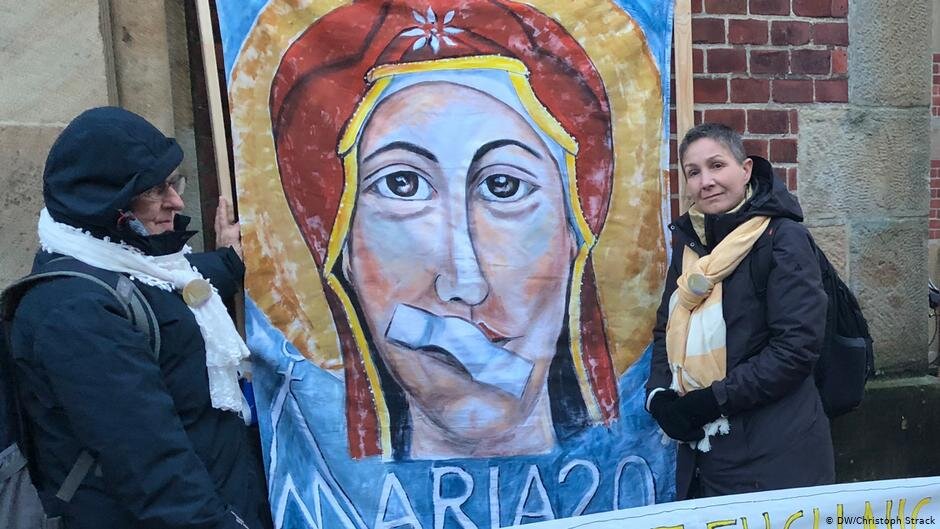
One of Maria 2.0’s symbolic pictures is the Virgin Mary with her mouth taped shut …. signifying her silencing and that of women throughout Church history.

One of Maria 2.0’s symbolic pictures is the Virgin Mary with her mouth taped shut …. signifying her silencing and that of women throughout Church history.

In May 2019, Maria 2.0 gained international prominence when it called for a German-wide Church strike for women. Women were encouraged to engage in a one week boycott of official services and their volunteer efforts in churches. Since then, momentum hasn’t stopped. Maria 2.0 has been organising other demonstrations for equal rights for women in the Church. One was the human chain around Cologne Cathedral in September.’ [2]

Maria 2.0 was born in a reading circle in Münster, Germany’s Holy Cross Parish. As the reading circle studied Pope Francis’s apostolic exhortation Evangelii gaudium, the spirit of the movement emerged. Women realised their solidarity in shared frustration around:

  • their exclusion from sacramental ministry on account only of their being women;

  • Church policy on mandatory celibacy ;

  • and the hierarchical fumbling of the sex abuse crisis.

The initiative is named for Jesus’s mother, the Virgin Mary who in German is known as Maria. Throughout Church history, Mary is held up as the Churchman’s ideal for women — silent, submissive, and obedient. This narrow version of a role model is unhelpful to women and is not true to the person of Mary. ‘2.0’ signifies the need for a Church reboot so that positive change can happen. Leader Barbara Stratmann points out: ‘2.0 stands for a new beginning. Reset everything to zero. We are no longer like that.’ [3]

Out of Shared Concern, A Movement is Born

As the movement solidified, members flagged their concerns and plans for action in an open letter to Pope Francis. A translation of it reads:

Open Letter to pope Francis [4]

Holy Father,

We women believe that Jesus of Nazareth announced his liberating message of love to us all — men AND women. We are mourning:

maria2.0 women's organ.png
  • all known and unknown abuse cases of all kind in the Roman Catholic Church;

  • the absence of plausible apologies and aid to those who have suffered from violence;

  • those who no longer believe in the church and its message.

We stand before the shattered remains of our affection and trust in our church with great disappointment, bewilderment and anger. We therefore call upon the Catholic Church, in accordance with many before us:

  • to deny office to those that have harmed others or have tolerated or covered up such wrongdoings;

  • to surrender all offenders to secular courts and to cooperate in all prosecutions without restrictions;

  • to allow women access to all church functions;

  • to abolish mandatory celibacy;

  • to align church sexual morals realistically with the reality of life.

The men of our church like to sing their praise to women. Paradoxically, men are the sole determiners of our participation in our church. As of now, only one woman is tolerated among them: Mary. On her pedestal. She stands there. Reduced to silence.

We want to take Mary off her pedestal and into our midst, as a sister facing our direction. We will act! We will post this letter to all church gates and call all women to action with MARY 2.0 From Saturday, the 11th until Saturday the 18th of May [2019] we will not enter the church and [we will] deny our service to the church. We want to make known how empty the churches will be without us and how much important work will be unfinished without us.

  • We will remain outside!

  • We will celebrate worship together on the church squares, in front of the church gates.

  • We will dance, sing, pray and find new words and expressions.

  • We will welcome all to participate, also men.

  • We will bring white sheets and cover the church squares in the colour of innocence, the colour of grief and compassion. We will use these sheets to paint, write, combine, stain and create with all ideas welcome as a collective. We will surround the church in the colours of new beginnings!

Yours sincerely,

The women and men signing this letter.

Link to the petition

Gospel logic means justice and mercy as the DNA of the Gospel. We want a Church that doesn’t exclude anyone, but invites everyone who sincerely asks about God. For me personally this is the best thing when women come to me… and say that they have not been in the church for 20 years and have found a home again through Maria 2.0. This is evangelisation in the best sense…The important thing for me is that we always keep in mind that God is greater and that the questions that we have can only point to that. We point to Christ. We are not Christ, we can only point to him and what he exemplified for us. For me that is the Gospel and for me that is the logic of why I am committed.

Maria Mesrian, Maria 2.0 Member 5

Church Boycotts

When I grow up, I will become Pope.

At a Church boycott, the image of the Virgin Mary has her mouth taped shut signalling her silencing by the Church hierarchy because she is a woman.

At a Church boycott, the image of the Virgin Mary has her mouth taped shut signalling her silencing by the Church hierarchy because she is a woman.

Founders of the movement invited all German Catholic women to participate in a boycott during the annual May devotions to the Blessed Virgin Mary (in 2019, May 11-18). As promised in their letter to Francis, women held services outside their churches and refrained from all church-related voluntary work. Church squares were covered with white sheets symbolizing charity, sorrow, and a new beginning . The white sheets also served as a canvas for expressing complaints and demands in creative and emphatic ways.

At least 50 locations participated in the boycott and included women and men. A vigil held on the Münsteraner Domplatz gathered 700-800 people.

Participation Outside Germany: Austria, Switzerland, and USA

Women in Austria have joined the movement. Women involved in the church in Switzerland organized their own boycott and also participated in the national women's strike. In Washington, D.C. , women joined forces by hosting an outdoor Mass — Mass On Mass —near the Vatican Embassy. The liturgy was led by two Roman Catholic womenpriests while cold rain fell.

Response to the Boycotts

From German Catholic Women’s Associations

Support came from large established German lay associations including:

  • Katholische Frauengemeinschaft Deutschlands (Kfd) — a large established association of German Catholic women;

  • Katholischer Deutscher Frauenbund (KDFB). - a large established association of German Catholic women. In support of Maria 2.0, KDFB President Maria Flachsbarth said abuse cases and cover-ups by priests were sinking the Church into deep crisis and credibility loss. She pointed out that striking women wanted to show how much the church and its evangelical gospel means to them. Flachsbarth is also a federal parliamentarian and member of Chancellor Angela Merkel's Christian Democrat (CDU) party. [6]

  • Central Council of German Catholics (ZdK) — Thomas Sternberg, President of the Central Council of German Catholics (ZdK) observed at its lay convention earlier in 2019, that ‘Without the women nothing happens.’ Sternberg predicts that emerging from German Synodal process and the protests of Maria 2.0 will emerge for the Church as a whole an ordained women’s diaconate and married men in priesthood. ‘Never before have I experienced a situation in which indignation extended so far into the core of our churches,’ he said. [7]

From Leading Churchmen in Germany

  • Catholic priests voiced their support;

  • Jörg Hagemann, the Dean of Münster took part in a Liturgy of the Word in front of the church where he later celebrated Eucharist;

  • Franz-Jozef Bode, the Bishop of Osnabrück and head of the German Women’s Commission of the Deutschen Bischofskonferenz, welcomed the initiative, stating that while it is problematic that women left the Eucharistic communion and held their own ceremonies in parishes, one had to recognize that the profound injury to many active women in the church is behind this impatience: they don't feel the approval in the church as their commitment deserves. In endorsing Maria 2.0, Bode said he regretted the boycott but that ‘one must be very perceptive of the impatience of many women in the Catholic Church. Behind it is a very deep wound — that they in the church do not feel accepted in relation to their efforts.’ [8]

  • The Archbishop of Freiburg, Stepan Burger expressed sympathy women's denial of access to the ordained diaconate and priesthood;

  • Matthias Kopp, spokesperson for the German Conference of Catholic Bishops recognised the need for change and discussion but said that boycotts and strikes were not an acceptable approach in the work for change;

  • Archbishop Georg Gänswein, personal secretary to the former Pope Benedict XVI (both Gänswein and the former Pope are now based in Rome but come from Germany) criticized the movement for risking the creation of a new church by tinkering around with the Church’s DNA.

Other responses

  • The Conservative Forum of German Catholics called for KDFB members who were "committed to the teaching of the Catholic Church" to depart the organization;

  • The Catholic Johanna Stöhr from the diocese of Augsburg responded by founding a counter-initiative Mary 1.0 in order to show, as she said, that there are also women who are faithful to the teachings of the church.’ Her slogan is, Mary doesn't need an update.;

  • Peter Winnemöller said that self invented services did not satisfy the Sunday obligation and that the boycott did not meet the requirements of a dispensation, therefore making the participants guilty of a mortal sin.

Unsurprised by some of the negative reactions coming from women like Johanna Stöhr, Münster's Holy Cross parish priest Stefan Jürgens observed, ‘That's what I have experienced in the 25 years I've been in the ministry: the fiercest opponents of priesthood for women are among women! They are just accustomed because of their upbringing that they are the ones serving; that they're rather subordinate themselves. But the young women can't stand it anymore.’ [9]

Maria 2.0 Website

Maria 2.0 Facebook Page

— contribution by Therese Koturbash, WOW Communications Team
Therese Koturbash, BA, LLB, GDCL served as Canadian Delegate to Women’s Ordination Worldwide from 2008 to 2013. For all five of those years, she was elected member of WOW's four person International Leadership Circle. She has also been the National Coordinator of Canada's Catholic Network for Women's Equality. Today, Therese serves on WOW’s Communications Team and is a volunteer with WOW member group, Wijngaards Institute for Catholic Research. Her paid work is as a family attorney.

Notes

  1. German Catholic women begin boycott over lack of reforms, dw.com, 2019-05-11.

  2. Mada Jurado, German Church women’s rights movement still striving for “equality and renewal”: member, Novena News, January 21, 2020.

  3. "Die Zeit der schweigenden Frauchen ist vorbei". Deutschlandfunk (in German). 2019-05-10.

  4. "Open Letter to pope Francis" (PDF). Maria 2.0.

  5. op cit, Mada Jurado.

  6. op cit, German Catholic women

  7. ibid.

  8. ibid.

  9. ibid.


Women Martyrs, Confessors and Early Presbytyrs (Priests)

St Prisca with lions

St Prisca with lions

Throughout the Church’s history, there have been women and men who witnessed to their Christian faith unto death.

According to ancient tradition, women or men on the way to martyrdom had the power to forgive sins. This is a function of priesthood. The Apostolic Tradition of Hippolytus (3rd cent) states that any confessor who had been imprisoned for faith automatically attains the rank of presbyter (priest) in the Roman communities.

Saints Irenaeus (2nd cent) and Cyprian (3rd cent) apply this power of martyrdom equally to women confessors. It underlines that in the early Church, women, just as did men, shared in the power of the keys — binding and loosening on behalf of Christ. The martyr St. Catherine of Alexandria is shown to have power in the engraving by Albrecht Dührer (see below left). The rack reminds us of her torture, the throne and sword of how she reigns with Christ.

Legend of Saint Prisca

Saint Prisca was a young Roman woman allegedly tortured and executed for her Christian faith. The dates of her birth and death are unknown. She is revered as a pre-schism Western saint and martyr by the Orthodox Church and as a saint and martyr by both the Roman Catholic Church and the Anglican Communion. Though some legends suggest otherwise, scholars do not believe she is the Priscilla (Prisca) of the New Testament couple, Priscilla and Aquila who were friends of the Apostle Paul.

Especially in England, she is honored as a child martyr. January 18 is her feast day.

Not a lot is known about Prisca. It is believed that she came from a noble Roman family and was very young when she died for her faith. She is sometimes represented by two lions, who are said to have refused to attack her at the Co iseum in Rome. Prisca suffered many tortures before she was finally beheaded on the Via Aventine. The Christians buried her body in a catacomb at the place of her death.

There still exists on the Aventine in Rome a church of St Prisca. It stands on the site of a much earlier church, the Titulus Priscoe, mentioned in the fifth century and built probably in the fourth.

Legend says that Saint Prisca was of a noble family. At age thirteen, she was accused of Christianity before Emperor Claudius. He ordered her to make a sacrifice to the god Apollo. When she refused because of her Christian faith, she was beaten and sent to prison.

The martyr St. Catherine of Alexandria is shown to have power in this engraving by Albrecht Dührer . The rack reminds us of her torture, the throne and sword of how she reigns with Christ.

The martyr St. Catherine of Alexandria is shown to have power in this engraving by Albrecht Dührer . The rack reminds us of her torture, the throne and sword of how she reigns with Christ.

Upon her release from prison, she still held steadfastly to her faith in Christ. This time her punishment included flogging, the pouring of boiling tallow upon her, and a second imprisonment. She was at last thrown to a lion in the ampitheatre but it quietly lay down at her feet.

She was starved for three days in a slaves' prison house, and then tortured upon the rack. Pieces of flesh were next torn from her body with iron hooks, and she was thrown on a burning pile.

She miraculously still remained alive, but was beheaded at the tenth milestone on the Via Ostiensis—the road from Rome to Ostia. The Christians buried her body in a catacomb at the place of her death, where now stands a church of St. Prisca and where previously stood a very early title church, the Titulus Priscoe, mentioned in the fifth century and likely built in the fourth.

________________________
With thanks to John Wijngards, Women’s Ordination Worldwide member group, Wijngaards Institute for Catholic Research and their website womenpriests.org.

- Therese Koturbash, Women’s Ordination Worldwide Communications Team
Therese Koturbash, BA, LLB, GDCL served as Canadian Delegate to Women’s Ordination Worldwide from 2008 to 2013. For all five of those years, she was elected member of WOW's four person International Leadership Circle. She has also been the National Coordinator of Canada's Catholic Network for Women's Equality. Today, Therese serves on WOW’s Communications Team and is a volunteer with WOW member group, Wijngaards Institute for Catholic Research. Her paid work is as a family attorney.

Signs of New Openness to Women's Ordination in Eastern Orthodoxy

New openness to women’s ordination among Eastern Orthodox theologians

by Richard Cimino | Religion Watch www.religionwatch.com

Although Eastern Orthodox churches remain opposed to the ordination of women priests, there is a growing openness among theologians to this possibility, even if they are not likely to become activists on this issue, writes Sarah Hinlicky Wilson in the journal Pro Ecclesia (Spring).

Elisabeth Behr-Sigel

Elisabeth Behr-Sigel

As might be expected, women are in the forefront of the effort to rethink female ordination in Orthodox churches, including a number of American Orthodox connected to the journal St. Nina’s Quarterly, as well as such scholars as Eva Catafygiotu Topping, Susan Ashbrook Harvey and Kalliope Bourdara. Many see the work of French Orthodox theologian Elisabeth Behr-Sigel (1907– 2005) as being the standard reference for the argument affirming women in the priesthood. What is more unexpected is that “several male Orthodox theologians have gradually moved toward Behr-Siegel’s position,” Wilson writes.

What is chiefly striking about them, though, is how much the substance of the opposition has changed…the older views that women are incompetent or physically unfit (due to ‘impurity’ from menstrual cycles) have been replaced by concerns about the nature of tradition and the priesthood and how it relates to personhood and gender (for instance, the teaching that the priest is the icon or representation of Christ)

Such prominent Orthodox theologians as Metropolitan Anthony Bloom, Kallistos Ware, Olivier Clement and John Zizioulas have gone on record stating that there are no compelling reasons against the ordination of women. Wilson notes that there are still many opponents of women’s ordination in Orthodox circles, “likely the majority within the churches and certainly a vocal contingent in publication. The articles range from popular diatribes to serious theological scholarship.

What is chiefly striking about them, though, is how much the substance of the opposition has changed.” She adds that the older views that women are incompetent or physically unfit (due to “impurity” from menstrual cycles) have been replaced by concerns about the nature of tradition and the priesthood and how it relates to personhood and gender (for instance, the teaching that the priest is the icon or representation of Christ).

-May 2010 issue of the newsletter Religion Watch www.religionwatch.com

_____________________

Mme Elisabeth Behr Sigel was, perhaps, the most significant Orthodox woman of the 20th century who delivered the 2003 Florovsky Lecture at Saint Vladimir’s Seminary. She was born in Alsace, France in 1907. Her father was Protestant and her mother Jewish. She studied theology at the Protestant Faculty in Strasbourg and then began a pastoral ministry. But it lasted only a year.

She then went to Paris to study theology. During her studies she came into contact with the Russian Orthodox diaspora and joined the Orthodox Church through her friends and colleagues of the Russian emigration. She was influenced by some of the most important theological figures of the era (Metropolitan Evlogy, Vladimir Lossky, Paul Evdokimov, Lev Gillet, Maria Skobtsova, etc.). At the age of 24, she officially embraced Orthodoxy. In time she met and married a Russian immigrant and engineer Andrý Behr.  They would have three children who would provide an impressive number of descendants.

During the Second World War, the family was living in Nancy where Elisabeth taught in the public school system. She was active in the resistance movement during the Nazi occupation.

After the war she taught at the Catholic Institute of Paris, the Theological Faculty of St. Sergius, the Ecumenical Institute of Tantur near Jerusalem and the Dominican College of Ottawa.  She was also member of the editorial board of the magazine Contacts. Behr-Sigel taught worldwide and published many orthodox books and articles in English, French, and German.

She served the Church in many capacities. She devoted much time and energy to the promotion of women in the Orthodox Church — respectfully, almost humbly but with firm conviction and solid theological arguments. She became known for her tireless ecumenical activity.

On November 26 2005, Elisabeth Behr-Sigel died while reading in bed. She was 98.

Her book, The Ministry of Women in the Church, is available in Greek, as well as a number of her articles published in Synaxis (Σύναξις) and Kath’Odon (Καθ’ οδόν).

Christopher d’Aloisio

Elisabeth Behr-Sigel, a father of the faith

She was undoubtedly the most famous Orthodox woman theologian of the 20th century. Elisabeth Behr-Sigel was born on 20 July 1907;  she left this world for eternity on 26 November 2005 at the age of  ninety-eight.

We inherited from this great lady a theological legacy of great value. All her life she was a faithful servant of the Lord. She has been a living witness of the ecclesiastical life in Western Europe for almost a century.

In homage to the memory of Elisabeth Behr-Sigel I would like to develop two themes that were dear to her and that are still relevant: the ministries of women in the Church and the Ecumenical dialogue. However, these of course were not the only interests of the theologian, but in these two topics, her contribution has been particularly significant.

One of the most sensitive issues that of the place of women in Orthodoxy leads us, from the start, to the issue of the diversity of ministries in the body of the Church. In fact, the Church of the first centuries knew a Wide diversity of ministries, a diversity that the passage of history has lessened, but never abolished. It is in this sense that we should understand the words of Saint Paul, particularly in the Epistle to the Ephesians (4, 7-13). The apostle also teaches the Corinthians that the diversity of Church ministries doesn’t go against the unity of the body; on the contrary, unity is based on the diversity of the charismatic gifts from the unique Spirit (I Corinthians 12). It is really the Spirit and not some member of the Church that establishes a faithful person in a function of Church service. Today and in many places, diversity has been replaced -for a while probably -by some hierarchical ministries in a manner foreign to the evangelical spirit because it is based on fear of authority. For the divine Paul and the apostolic tradition, the authority of the Church is conceivable only in a communion of love and not in relationships of hierarchical domination (cf. Romans 12,3-21). It is not impossible that we have here, in this evolution, one of the historical reasons for the disappearance, in Orthodoxy of a variety of ministries within the Church.

The participation at the Eucharistic Liturgy is a parameter that allows us to evaluate the evolution of the ways the Church is administered. In the authentic tradition it is clear that the Eucharist is the hieratic act accomplished by the whole body of the Church. During the Liturgy it is the assembly of the whole Church that offers the oblation to God the Father, because by the incorporation of the Church the baptised are at the same time consecrated to and participating in the vocation of Christ the High Priest. Across the centuries, especially since the Constantinian and Justinian periods, the Church has made its administration more systematic in the manner of the imperial State, establishing an ontological separation between the simply baptised and the ordained ministers as if only the latter were consecrated. The model has prevailed in the Eastern Church until our days, with more or less success. The transformation of our societies and particularly the emergence of Orthodox communities in countries of Western Europe has given the Church since the 20th century the possibility to reflect again on the question of ecclesiastical functions. Our theology has never denied the richness of the first times, evidence of the living and life giving presence of the Holy Spirit in the assembly of the Saints, the ecclesia of the all the consecrated faithful.

Nowadays, the diversity of ministries taken on by the faithful that have not been ordained to the diaconate or to the priesthood is more obvious. Generally, everyone already agrees that it is imperative to give a greater place to the service of the laity in the Church community. Functioning of laity as teachers of catechesis is an obvious example. The question of diversity of ecclesiastical functions is put back on the agenda, certain functions are to be redefined others to disappear or reappear.

The question of feminine ministries in the Church is part of the current questioning of the ministries. Within the framework of reflection on the history and theology of the feminine diaconate led by the group “Femmes et hommes dans l’ Eglise” (Women and men in the Church), Elisabeth Behr­ Sigel, together with a group of clergy and lay people, wrote, in Autumn 2000, a letter to the primates of all the patriarchal, autocephalous and autonomous Orthodox Churches in favour of a creative restoration of deaconesses. The magazine Service Orthodoxe de Presse gave an account of this event: ” … the Signatories underline that the possible restoration of the feminine diaconate constitutes an important question that has been asked of our Church and in our Church for decades. This ministry, they remind us, existed and was flourishing in the time of the Fathers of the Church, as has been shown by serious historical studies. It was at the time quite a complete ministry, liturgical, catachetical and philanthropic at the same time, adapted to the social structure of the age. This question was put back on the agenda at the beginning of the 20th century by the initiative of Saint Nectarios of Aegina, a Greek bishop who died in 1922, and by Saint Elizabeth, Grand-Duchess of Russia, martyred in 1918. But it is particularly in the last 30 years in the context of a deep cultural mutation and of ecumenical dialogue that the possible restoration of deaconesses imposes itself on (he conscience of the Orthodox Church as a burning problem.

In the case of ordination to the priesthood, there is still a certain amount of reflection to be done, said Elisabeth Behr-Sigel. Nowadays the arguments going against such an ordination can be summed up by the symbolic or iconographic character of the function of the priesthood. The theologian Behr-Sigel proposes to diminish this argument, reminding us that the Eucharist is not only a memorial, but also an anticipation of the banquet in the Kingdom where the division of the sexes as we know it will be changed. “To insist heavily on the masculinity of Christ, God made man -anthropos-is it not falling into a form of Nestorianism? That is to say deny the real union in Christ of God and Man. This question was asked by the theologians present in Rhodes [at the pan-Orthodox consultation on the place of women in the Church and of ordination of women, organised by the Ecumenical Patriarchate from the 30th October to 7th November 1988]. Elisabeth Behr-Sigel goes on to propose a deepening of the notion of the person being the image and resemblance of God. She warns against a possible distortion of the understanding of the icon: it is not a naturalist portrait. “In the martyrdom of Blandine (of Lyon) attached naked to a stake, offered by her executioners to the beasts and offering herself in sacrifice to God, in the ecstasy of faith and love, her companions in the fight contemplated ‘the image of Christ’ who was comforting them. ‘She was for her brothers an exhortation. She, the little one, the feeble one, the despised, who had put on the great, invincible athlete, the Christ. Thus said the letter of the Christians of Lyon to the Churches of Asia Minor cited by Eusebius in his History of the Church (Eusebius of Caesarea, Histoire Ecclesiastique,1. ll, Sources chretiennes, 1955, p. 17). Is it not this kind of transparency -how unreachable to the sole human strength -that is expected from the priest ?’

These few words do not sum up exhaustively the thoughts of Elisabeth Behr-Sigel and I only submit them to your charity for reflection and not necessarily in order to convince you. She herself, actually, was not what one could call a militant, but a lay theologian who put her reflection at the service of the Church. She always knew how to step aside before the pastors covered with the charisma of authority and her propositions were never peremptory affirmations, but an effort to revitalise the Church life. She insisted particularly on the fact that the impossibility of giving a simple answer does not exempt from the duty of asking complex questions.

In the field of relationships between divided Christians, Elisabeth Behr-Sigel played a pioneering role. Coming herself from Protestantism, she has always kept a strong link with her roots, a questioning capacity about the reality of Orthodoxy, that could have become sclerotic. From her youth, she understood her attraction to Orthodoxy not as a rejection of Western Christian experiences, but as a deepening of those. Through her friendship with Fr. Lev Gillet, the “Monk of the Eastern Church”, Elisabeth Behr-Sigel knew the painful beginning of the dialogue between Christians, practically outlined by Protestants followed by Anglicans on one side of Europe, and the Church of Constantinople on the other side, quickly followed by all the patriarchal, autocephalous and autonomous Orthodox Churches. The Roman Catholics joined the movement next and in a different way. For Elisabeth Behr-Sigel as for all the people who have inspired the ecumenical movement, the dialogue and the search for unity is not an optional choice of ecclesiastical hierarchies, nor a professional speciality to some elite clergy, but a way of being among Christians, an existentia1 necessity that affects the witness of the unique Church of Christ in the world. Very significantly, in her writings, the French theologian names the Churches in the way they name themselves and not in the way the other Churches qualify them; for example, she only uses with quotation marks the adjective “uniate” for the reason of the pejorative connotation with which this qualifier is filled, in the benefit of the “Catholics of Eastern rite”.

She did not ignore the resurgence of proselytism in some Christian communities of Western origin dispersed in Eastern Europe, but she kept a critical distance from the events and knew how to witness a great respect for the other Christians without condemning a whole Church family due to the indigenous behaviour of some of its members. The attention given by Elisabeth Behr-Sigel to the terminology is a sign of patristic wisdom; our tradition gives a great importance to names.

In the same way she was reluctant to use the word “Churches” in the plural when discussing dialogue towards unity, because in this approach. it is the One and Holy Church of Christ that manifests itself in a process of reconciliation. The division of the Body is unbearable when the Gospel is open before us.

At last with many other Orthodox thinkers, Elisabeth Behr-Sigel understood as a manifestation of the providence of God the presence of Orthodoxy in the West. For her, the Orthodox of Western Europe are charged with a particular mission because of their permanent contact with other Christians: to formulate the Orthodox Tradition of the Church in a renewed language, in a world which is in constant evolution. Like the Fathers of the Church, we have to proclaim the mystery of salvation in an intelligible way for the people we speak with. It is not we who choose the people with whom we cross paths, it is the Father who sends them to us, or rather who sends us to them. To talk to the world today, we have to love it in its strengths and in its weaknesses, and tell it about the Christ we know. This great lady, Elisabeth Behr-Sigel, was sought to take on this charge until the dusk of her life, with true pastoral concern towards the next generations. May God rest her soul in peace and grant her eternal memory.

From the journal Syndesmos news, v. XIX, 1, 2006.

'Burning Books' or 'Karma Bites Back' - Therese Koturbash

Newspapers and social media these days are brimming with details of the controversial and just released book From the Depths of Our Hearts. It claims to be co-authored by Cardinal Robert Sarah and the former Pope Benedict. The book issues ‘an ardent defense of clerical celibacy. (Sidebar: It also includes a chapter denouncing ordination of women as deacons or priests.)

As such, the book puts both Francis and Benedict in awkward positions. In breaking his pledge to silence on church affairs made when he abdicated the papacy, Benedict does so just as Pope Francis is considering opening the door to married men to priesthood. 1 The predicament of a former pope publicly contradicting the actual Pope puts the Church in an awkward space. Benedict’s speaking out creates inner-church tension that many worried about when he stepped down seven years ago. Benedict’s vow of silence on key issues was made out of respect for Francis who is the pope.

That was yesterday’s news.

Drama heightened today as Benedict’s personal secretary, Archbishop Georg Gänswein says that Benedict (who is declining) never agreed to participate as co-author and that his name must be removed from the book. 2

A practical question comes to mind: What does one do with published books after one of the supposed authors asks to have his name removed? Burn them?

This brings us to the theme of this post — karma bites back.

Women at the altar : the ordination of women in the roman catholic church by Lavinia Byrne

Women at the altar : the ordination of women in the roman catholic church by Lavinia Byrne

In 1994, Sister Lavinia Byrne, IBVM (as she then was) learned that under pressure from the Vatican’s Congregation for the Doctrine of the Faith (whose prefect at the time was Cardinal Joseph Ratzinger — as he then was — he went on to become Pope Benedict), the Liturgical Press of Collegeville, Minnesota would be burning all 1300 copies of her new book, Women at the Altar: The Ordination of Women in the Roman Catholic Church. The book is an account of reactions to the ordination of women priests in the Church of England. 3 It argues that since the key building blocks for such progression are already in place, tradition could appropriately be developed to encompass women's ordination in the Roman Catholic Church. By 1993 when Byrne was completing the work, biblical scholars commissioned by the Vatican had discerned that scripture held no impediments. Tradition had been revisited and was found not to be absolute. Byrne writes, ‘The ordination of women to the priesthood is the logical conclusion of all the recent work of Catholic theology about women and in particular about the holiness of all the baptised. It is not an aberation from what the Church teaches, but rather a fulfillment of it so that not to ordain women would now be to compromise the Catholicity of the church.’ 4

The ordination of women to the priesthood is the logical conclusion of all the recent work of Catholic theology about women and in particular about the holiness of all the baptised. It is not an aberation from what the Church teaches, but rather a fulfillment of it so that not to ordain women would now be to compromise the Catholicity of the church.4
- Lavinia Byrne

Byrne’s intention for the book was not to attack or be directive to the Vatican. But, given his order for destruction of the published copies, Cardinal Ratzinger made obvious that he perceived her academic work to be a threat.

The journey is my home, autobiography of Lavinia Byrne

The journey is my home, autobiography of Lavinia Byrne

Byrne responded by pointing out that the book was written in good faith and during a time of free and open discussion about women’s ordination. But shortly after the order for burning, John Paul II issued his Apostolic Letter, Ordinatio Sacerdotalis. In what is now known as ‘the Papal No’, JPII prohibited discussion of the issue by the faithful and formally restricted priestly ordination to men only. He said that should anyone even discuss the subject of women’s ordination, they should consider themselves to be out of communion with the Church.

The CDF demanded that Byrne recant her work and make a public statement supporting the ban on women priests. Instead of recanting, on January 6, 2000, ‘with deep regret’ 5 she asked to be dispensed from her vows. Weary of the saga and the fact that the Vatican refused to deal with her as an individual (the CDF insisted on communicating with her through her community's Superior General in Rome thus creating tension affecting others, and Byrne's relations with them), Byrne decided to leave her Order. ‘I am resigning because of the pressure from the CDF. I'm being silenced as a member of a religious order. The Congregation for the Doctrine of the Faith won't to talk me directly but to my religious superiors, and that strategy of not dialoguing with me has become untenable.’ 6

Byrne thereby became one of the first ‘survivors’ of the Vatican’s campaign against any work for women’s ordination.

Her work was not an ‘act of subversion [but instead] an informed attempt to place the changing role of women into context.’7 She makes no secret of her childhood wish to be a priest. ‘When I was little I had no idea that being a girl debarred me from ordination. It was a painful truth when I realised at around the age of 10 that I could not be ordained because I was a girl.’8

Byrne’s more recent work is an autobiography, The Journey Is My Home. It is described this way:

‘Lavinia Byrne entered her convent at the age of seventeen. Her writing and broadcasting have made her a popular and much-loved figure, and therefore it was a huge shock when, in January 2000, she announced her decision to leave her order. This is the powerful story of one woman's struggle to keep her integrity in a Church still using techniques reminiscent of the Inquisition.’

Women at the Altar: The Ordination of Women in the Roman Catholic Church continues in publication today.

-Therese Koturbash, Women’s Ordination Worldwide Communications Team
Therese Koturbash, BA, LLB, GDCL served as Canadian Delegate to Women’s Ordination Worldwide from 2008 to 2013. For all five of those years, she was elected member of WOW's four person International Leadership Circle. She has also been the National Coordinator of Canada's Catholic Network for Women's Equality. Today, Therese serves on WOW’s Communications Team and is a volunteer with WOW member group, Wijngaards Institute for Catholic Research. Her paid work is as a family attorney.


Notes:

  1. ‘Benedict defends priestly celibacy as Pope Francis considers changes’, Chico Harlan, The Washington Post, January 12, 2020

  2. Benedict wants his name removed from book about priestly celibacy’, Chico Harlan and Michelle Boorstein, The Washington Post, January 14, 2020

  3. The Accidental Rebel, The Irish Times, February 24, 2000

  4. ibid.

  5. ibid.

  6. ibid.
  7. ibid.

  8. ibid.

Feast of the Baptism of Jesus: January 12, 2020 -- Rev. Dr. Shanon Sterringer

Reading One:  Isaiah 42: 1-7

Psalm:  The Lord will bless his people with peace

Reading Two:  Acts 10: 34-38

Gospel: Matthew 3:13-17

This weekend we celebrate the Baptism of Jesus. 

green baptismal bowl.jpg

Jesus’ baptism has been the source of much theological debate given that the tradition has maintained baptism is the means by which we are freed from the stain of original sin – if Jesus was without sin, why did he seek out John in the Jordan to be baptized?

Like all of our traditions, the doctrine of original sin developed within the lived experience of the community. This development can be seen in the scriptural passages themselves. If we set the Gospels next to each other in the order in which they were written – Mark, Matthew, Luke, John – there is a minimum of a 70-year time span between Mark and John. Over this block of time there is a clear development in the theology of Jesus’ baptism. In the Gospel of Mark, Jesus simply comes to John and is baptized. In the Gospel of John, there is no mention of water ever even touching Jesus’ head – John sees Jesus and begins to preach a discourse on who Jesus is. In the passage we just heard proclaimed today from Matthew, Jesus is baptized but with some hesitation on John’s behalf – “It is I who needs to be baptized by you…” 

The teaching that baptism is necessary to wash us free from original sin was not handed to us directly by Jesus. It was St. Augustine, several centuries later, who made the direct connection between the sin of “Adam and Eve” and the need to be baptized in order to be released from it. 

The Book of Genesis claims all human beings are created in the imago Dei – how can someone from the moment they are miraculously conceived in the womb in the image and likeness of God, be inherently marked with a stain so severe it can only be cleansed through the tradition of one major world religion? This theological concept has become even more difficult to explain and understand in the midst of scientific developments which affirm our human history is much more complicated that the Adam and Eve story – how we evolved and in what manner is debated, but most agree we evolved in some way.  We have been taught that death entered into the world when Adam and Eve ate the fruit from the forbidden tree. Reality is, from the moment this earth was created, death has been present. The dinosaurs died tragically long before human beings were created. 

For St. Augustine’s theology of how original sin is passed down to make sense, we need to assume Adam and Eve are the first set of parents from which every other human being descended.  From this story (Genesis 1-3) we have formed an image of a world with one set of fully formed parents commanded to beget children and populate the earth. The image of Eden most of us have been taught depicts a scene where no other human beings exist. I would like to read an excerpt from chapter 4 of Genesis:

The man (Adam) had intercourse with his wife Eve, and she conceived and gave birth to Cain, saying, “I have produced a male child with the help of the LORD.”  Next she gave birth to his brother Abel... When they were in the field, Cain attacked his brother Abel and killed him. Then the LORD asked Cain, Where is your brother Abel? He answered, “I do not know. Am I my brother’s keeper?” God then said: What have you done? Your brother’s blood cries out to me from the ground... You shall become a constant wanderer on the earth. Cain said to the LORD: “My punishment is too great to bear... Anyone may kill me at sight.” Not so! So the LORD put a mark on Cain, so that no one would kill him… Cain then left the LORD’s presence and settled in the land of Nod, east of Eden. Cain had intercourse with his wife, and she conceived and bore Enoch. Cain also became the founder of a city, which he named after his son Enoch.

Who were all of these people who might kill Cain? Where did Cain’s wife come from? Who were the people living in the land of Nod, if they had not descended from Adam and Eve? You get the point I am trying to make – these stories were not written to be read literally as historical or scientific texts, yet we have developed centuries of infallible teachings based on biblical fundamentalism. Most of our dogmatic teachings have little to do with love, and even less to do with Jesus, and are really centered around institutional power and law. 

Putting the distorted idea of original sin aside, how do we reconcile Jesus’ baptism in the Jordan by the prophet John the Baptist with a healthy understand of baptism today?

Baptism is a sacrament of gifts. In last week’s gospel we heard that Jesus received three gifts: gold, frankincense, and myrrh. These gifts are symbols of the gifts we each receive in baptism - gold represents our divine nature; frankincense our baptismal priesthood; and myrrh our prophetic call.  

In our baptism we are endowed with the gifts of the Holy Spirit – gifts including courage, understanding, wisdom, and strength. The gifts of the Holy Spirit we receive at baptism are sealed at our confirmation and renewed through the sacramental life of the Church. We are gifted in so many ways, but we are not always aware of our potential.

A contemporary image that comes to mind when I think about the sacrament of baptism is the Wizard of Oz. We, like the characters in the story, are drudging along on our journey not always aware that we already have the gifts we seek – courage, compassion, intelligence. The institution is in many ways like the Oz – creating an impression that the power lies behind a “proverbial curtain” and is dispensed at the will of the great and powerful magisterial Oz. When the curtain is pulled back, we realize most of what we feared and/or believed to be true, was not authentic. Isaiah 2:22 reminds us, “Do not put your trust in human beings, they are frail” – we are painfully becoming aware of this today. 

We are called – actually we are commanded – to place our faith in God alone, not in human beings or institutions. There are a growing number of scientists suggesting that the entire universe – even what seems to be inanimate objects – have consciousness. 

Stop for a moment and consider this image – the presence of God within and around us in every part of our being. Every aspect of the created world existing with the divine consciousness – within the mind of God – this is extraordinary. How can it possibly be contained – or limited – by any particular creed or doctrine? This idea of a universal consciousness is the message the mystics from every world religion have been trying to communicate for as long as human beings have been able to communicate. We are not separate from God – we are created in God’s image and likeness – we are one with God.

For St. Hildegard of Bingen, and many other enlightened humans, this universal consciousness is described as the Living Light – the force that creates, animates, and sustains all that exists.  It is an energy from which all that exists has emerged. This awareness can be seen in the prologue of the Gospel of John: In the beginning was the Word and then the Word become flesh. Words are energy.

What does this mean in relation to the sacrament of baptism? When we are baptized, as Jesus was baptized, we recognize we belong to a reality much greater than ourselves. We are affirmed in our royal, priestly, and prophetic nature and are endowed with the Gifts of the Holy Spirit to help guide and sustain us as we grow in our relationship with God, each other, and all of creation. Baptism wakes us up to our divine nature. It is on some level necessary for salvation, not because it washes away a horrid stain assigned to all humanity, but because it showers us with an abundance of grace giving us eyes to see and ears to hear the presence of God all around us.  Can we come into this awareness without the sacrament of Baptism? Of course. But we recognize the gift of Living Water offered to the Samaritan Woman at the Well, and to us in baptism, is a gift consecrated and shared by Christ himself.

Rev. Dr. Shanon Sterringer
——————————————

Rev. Dr. Shanon Sterringer

Rev. Dr. Shanon Sterringer

Rev. Dr. Shanon Sterringer is a theologian and an ordained priest (ARCWP) with over two decades of pastoral experience and a strong advocate for holistic health/spirituality.  Her background includes a Ph.D. (2016) from Union Institute & University in Ethical and Creative Leadership (she focused on the example of St. Hildegard of Bingen); a D.Min (2012) and a MA in Theology (2007) from St. Mary's Seminary and Graduate School of Theology; a MA in Ministry (2011) from Ursuline College; and a BA (2003) from Cleveland State University.   She is a certified minister. She has training in pastoral care/counseling and sacramental preparation including marriage and funerals. She has received a number of awards and acknowledgements over the years for her academic and pastoral achievements.  She is the author of a daily meditation book, 30 Day Journey with St. Hildegard of Bingen (fortress press 2019).

She is married and is the mother of 3 beautiful adult daughters.  In her spare time she is an amateur beekeeper and she loves to be outside walking, collecting Lake Erie Beach Glass, and reading. 

Her greatest passion is St. Hildegard of Bingen and her second spiritual home is on the Rhine River in Germany! She has dedicated her life to discovering creative ways to help others renew their greenness (viriditas) of mind, body, and spirit.  

Shanon’s blog can be found at thegreenshepherdess.org

https://thegreenshepherdess.org/f/feast-of-the-baptism-of-jesus

Copyright © 2018 The Green Shepherdess - All Rights Reserved.


When God fashioned the man - Aelred of Rievaulx

Saint Aelred of Rievaulx

Saint Aelred of Rievaulx

Equality of women is not a new idea. It is just one that has had lots of resistance. Here from the 12 century is the supportive voice of St. Aelred of Rievaulx:

When God fashioned the man, to recommend society as a higher blessing, he said, 'it is not good that the man should be alone; let us make him a helper like himself' ... this power created a woman from the very substance of the man. In a beautiful way, then, from the side of the first human a second was produced, so that nature might teach that all are equal or, as it were, collateral, and that among human beings—and this is a property of friendship—there exists neither superior nor inferior.

- Saint Aelred of Rievaulx (b. 1110–d. 1167) was a writer, historian, and Cistercian abbot in England. This wisdom comes from his work, Spiritual Friendship. His feast day is January 12 — the anniversary of his death.

Catholic Women's Equality Requires A Shift On The Night Watch - Nicole Sotelo

Catholic women's equality requires a shift on the night watch

by Nicole Sotelo
National Catholic Reporter | January 5, 2017

One hundred [and two] years ago, Jan. 10, 1917, was a cold Wednesday morning. There was nothing exceptional about the day and that's important to note. Women's history isn't made in exceptional moments. It is often made by the long striving of a woman who has called together some friends for a cup of tea and their conversation leads to freedom, whether in society or the church.

Members of Women’s Ordination Worldwide marches with Maryknoll Fr. Roy Bourgeois down Via della Conciliazione toward the Vatican during a demonstration Oct. 17, 2011, in Rome. (CNS/Paul Haring)

Members of Women’s Ordination Worldwide marches with Maryknoll Fr. Roy Bourgeois down Via della Conciliazione toward the Vatican during a demonstration Oct. 17, 2011, in Rome. (CNS/Paul Haring)

I don't know if tea was brewed on this particular January morning, but I do know that after much discussion by Alice Paul and other suffragists in preceding weeks, a dozen women of the National Women's Party met at their headquarters in Washington, D.C. They picked up cloth banners and marched across Lafayette Park to stand in front of the White House.

Once unfurled, passersby read the homemade signs: "MR. PRESIDENT WHAT WILL YOU DO FOR WOMAN SUFFRAGE" and "MR. PRESIDENT HOW LONG MUST WOMEN WAIT FOR LIBERTY." Indeed, women had been waiting for generations.

At the time, nearly 70 years had passed since the first women's rights convention in Seneca Falls, N.Y., Susan B. Anthony and Elizabeth Cady Stanton had passed away. A new generation of women had entered the movement, one that was seemingly slow in progress. Having failed to secure a federal amendment for equal suffrage, women now campaigned state by state in an arduous bid for freedom, in addition to ongoing federal lobby efforts.

When Alice Paul and her friend, Lucy Burns, helped initiate this fresh protest at the federal level, it was equally arduous. They and other women from the National Women's Party signed up for shifts to hold the banners outside the White House through the soul-shivering winter. After World War I began that spring, public sentiment swept against them as traitors for protesting the president during wartime. By summer, the women began to be arrested, released and often arrested again.

Alice Paul January 11, 1885 – July 9, 1977) was an American socialist, suffragist, feminist, and women's rights activist, and one of the main leaders and strategists of the campaign for the Nineteenth Amendment to the U.S. Constitution, which prohib…

Alice Paul January 11, 1885 – July 9, 1977) was an American socialist, suffragist, feminist, and women's rights activist, and one of the main leaders and strategists of the campaign for the Nineteenth Amendment to the U.S. Constitution, which prohibits sex discrimination in the right to vote. Paul initiated, and along with Lucy Burns and others, strategized events such as the Woman Suffrage Procession and the Silent Sentinels, which were part of the successful campaign that resulted in the amendment's passage in 1920.

The punishments against the women intensified and later peaked that November during what became known as the "Night of Terror." Authorities sent the arrested protesters to a local workhouse that served as a prison for low-level offenders. The workhouse superintendent ordered the guards to attack the women. Lucy Burns was hung by handcuffs. Another woman was knocked unconscious and a fellow woman protester, assuming her colleague was dead, suffered a heart attack.

As news spread about their suffering, public sentiment began to sway back in favor of the women. Concurrently, the National American Woman Suffrage Association had continued lobbying for the federal amendment, saying it would be a measure of goodwill to the women who were aiding the war effort.

The imprisoned women were released and in the new year President Wilson, who previously had dismissed the cause, now made a public statement of support for a women's suffrage amendment. By August of 1920, the right for women to vote became law. This Tuesday marks the 100th anniversary of the White House protest, one of the many paths that cleared the way toward that law.

I recall this story because it is one that we need to hear this year as Catholics. The struggle for a woman's right to vote in civil politics may be over, but the struggle for a woman's voice in church polity is still very much alive.

The suffragists' story gives encouragement to those who suffer today. The Vatican and other Catholic officials may not lock people up, they do try to lock people out. The Vatican has issued official excommunication decrees against a handful of women involved in the Roman Catholic Womenpriests movement and threatened self-excommunication against the rest, something that the women themselves reject. Countless priests, scholars, and others like [Lavinia Byrne, Carmel McEnroy, Fr. Ed Cachia, Bishop Wm. Morris,]Roy Bourgeois, Ada María Isasi-Díaz and Rosemary Radford Ruether suffered professional consequences as a result of their support for Catholic women's equality.

The suffragists' story reminds us that change happens. After last year, when Pope Francis reaffirmed the finality of the ban against women's ordination when asked by a reporter, it is heartening to remember that President Wilson once said something similar when asked about women's suffrage. While Wilson was still governor of New Jersey, he responded in a letter to a Vermont newspaper editor, "I must say very frankly that my personal judgment is strongly against it. I believe that the social changes it would involve would not justify the gains that would be accomplished by it." Of course, he later championed the cause.

Moreover, the suffragists' story needs to be retold because it offers hope. Remember that the women one hundred years ago had no idea that they were on the verge of victory. They only knew that they were not yet free. And so they stood with their banners, perhaps for the sake of justice in their own lives. Blessedly, they were standing for us, too.

I only hope that we Catholic women and allies can do the same for future generations of the church. Whether it is midnight or close to dawn on the journey to justice, only heaven knows. What I do know is that we are needed to take our small shift on the long night watch for Catholic women's equality.

May we all put in an hour, or maybe two. So when dawn comes, whether this year or a hundred years from now, we will have done our part for the generations after us.

As Alice Paul's health failed, she continued to campaign for the Equal Rights Amendment and to watch as a new generation of activists sought liberation in the 1970s. During an oral history interview in the years before her death, she remarked:

"So I think if we get freedom for women, then they probably are going to do a lot of things that I would wish they wouldn't do; but it seems to me that isn't our business to say what they should do with it. It is our business to see that they are free." Indeed, it is.

Nicole Sotelo

Nicole Sotelo

[Nicole Sotelo is the author of Women Healing from Abuse: Meditations for Finding Peace, published by Paulist Press, and coordinates WomenHealing.com. She is a graduate of Harvard Divinity School.]

https://www.ncronline.org/blogs/young-voices/catholic-womens-equality-requires-shift-night-watch

Canon Law: Women Prohibited from Ministries of Acolyte and Lector -- This Calls Into Question the Equal Dignity of the Baptised

French women denounce exclusion as Eucharistic ministers: “It calls into question the equal dignity of the baptised” By: Mada Jurado | Novena News | January 10, 2020

French women denounce exclusion as Eucharistic ministers: “It calls into question the equal dignity of the baptised” By: Mada Jurado | Novena News | January 10, 2020

Can. 910

§1. The ordinary minister of holy communion is a bishop, presbyter, or deacon. <Canon law systemically discriminates against women here because it sets ordination as a pre-requisite for being an ordinary minister of communion. Since women cannot be ordained, they cannot be ordinary ministers of holy communion.>

§2. The extraordinary minister of holy communion is an acolyte or another member of the Christian faithful designated according to the norm of can. 230, §3. <Here the Church systemically discriminates against women through canon law. Why? Only laymen can be admitted to the ministry of lector or acolyte. See Canon 230, §1 below.>

Can. 230

§1. Lay men who possess the age and qualifications established by decree of the conference of bishops can be admitted on a stable basis through the prescribed liturgical rite to the ministries of lector and acolyte. <emphasis is our’s to highlight that only men — and not women — are permitted to be admitted to ministry of lector and acolyte (acolyte is altar server, minister of communion)

Nevertheless, the conferral of these ministries does not grant them the right to obtain support or remuneration from the Church.

§2. Lay persons can fulfill the function of lector in liturgical actions by temporary designation. All lay persons can also perform the functions of commentator or cantor, or other functions, according to the norm of law. <Women can be lectors only on a temporary basis when it is not convenient for the bishop, priest, or deacon OR lay men admitted to the ministries of lector/acolyate are available. See below .. ‘When the need of the Church warrants it and ministers are lacking… then and only then are women are a temporary option.>

§3. When the need of the Church warrants it and ministers are lacking, lay persons, even if they are not lectors or acolytes, can also supply certain of their duties, namely, to exercise the ministry of the word, to preside over liturgical prayers, to confer baptism, and to distribute Holy Communion, according to the prescripts of the law. <‘When the need of the Church warrants it and ministers are lacking… then and only then are women are a temporary option for distribution of Holy Communion. A priest is not compelled to allow women to perform this service.>


Note: At the Synod on the Amazon (2019), Synod Fathers reflected on whether women be included in the ministries of the lectorate and the acolyte, reserved only for males by the motu proprio Ministeria quaedam by Paul VI (1972) and by can. 230§1 of the Code of Canon Law (1983).

Story in context:

French women denounce exclusion as Eucharistic ministers: “It calls into question the equal dignity of the baptised” By: Mada Jurado | Novena News | January 10, 2020

If we reject gender discrimination in every other arena, why do we accept it in religion? - Beatrice Alba

If we reject gender discrimination in every other arena, why do we accept it in religion?

by Beatrice Alba
The Guardian | March 5, 2019

Young women and girls deserve better than what mainstream religion offers them

Cardinal Pell’s recent child sexual abuse conviction has been the catalyst for criticisms of women’s lack of authority in the Catholic church. But why has it taken a crime of this magnitude for criticism of the church patriarchy to gain traction?

Perhaps it’s partly timing – with the rise of online activism and in the wake of the #metoo movement, many feminist causes are gaining mainstream support.

‘Male religious authorities go out of their way to exclude women, yet many women follow them regardless’ Photograph: Linda Nylind/The Guardian

‘Male religious authorities go out of their way to exclude women, yet many women follow them regardless’ Photograph: Linda Nylind/The Guardian

The church’s exclusion of women from the priesthood and the sexist notions embedded in religious dogma violate our 21st century principles of equality and social justice. Yet the marginalisation of women in religion has come under surprisingly little scrutiny.

Anti-discrimination laws in the Sex Discrimination Act mean that organisations in Australia must not discriminate against any individuals based on their gender. But the law allows for special exemptions, such as religious grounds. Under these exemptions, religious organisations are free to refuse to allow women to ordain as clergy.

Sexism and misogyny are explicitly woven into the dogma and traditions of all mainstream religions. God is personified as male, and his representatives are male. Men are believed to be of higher spiritual authority to women, and many religions do not allow the full ordination of women into the clergy. Some religions disallow women from sitting at the front in their places of worship, and some places of worship refuse entry to women. Religious texts espouse notions of the mental, moral, and spiritual inferiority of women, and religion is used to justify gross forms of gender inequality all around the world.

Teaching girls that they are equal and deserve full participation in public life is inherently at odds with many religions.

Male religious authorities go out of their way to exclude women, yet many women follow them regardless. The existence of these double standards suggests that, as a society, we find this marginalisation of women acceptable and somewhat immune to challenge.

However, we should question the ethics of imposing these sexist and misogynistic views on children. It is difficult to understand the justification for exposing girls and young women to a doctrine that teaches them that they are inferior, or that they can only ever occupy restricted roles in the religion they are indoctrinated into. This instills girls at an early age with ideas that they do not belong in positions of authority and leadership. Research shows the harm done by setting such bad examples.

Young women and girls should be reminded that they have every right to reject the sexist and misogynistic ideas imposed on them by men who see them as their inferiors. They are entitled to be angry at those who attempt to dictate their position, their role, and their choices. They do not owe these men deference, and they should question why they are treated with such disrespect. Young women and girls deserve better than what mainstream religion offers them. A good education and good parenting means teaching young people that they are free to think and choose for themselves, and we should equip them with the skills to do so.

Religion’s endorsement of male supremacy is inconsistent with 21st century values of social justice and gender equality. Teaching girls that they are equal and deserve full participation in public life is inherently at odds with many religions. Children have the right to be free from discrimination, and it is an abuse of their human rights to not treat them with equality and respect. If we reject discrimination on the basis of gender in every other arena, why do we accept it in religion? We should not make exceptions for gender discrimination – the same discrimination and prejudice along racial lines would not be tolerated.

People have the right to practice their religion as they wish if they aren’t harming anyone. But given that religious organisations have special exemptions from anti-discrimination law, as well as special tax exemptions, any retort that critics should mind their own business doesn’t hold up. While such exemptions remain, any citizen can rightfully question these double standards.

Yet religion is seen as sacred, and we find ourselves walking on eggshells around the topic. But as long as religions disrespect and marginalise almost half of the population, they should not be immune to criticism.

We need to ask ourselves what is really sacred: respecting the traditions of a bygone era, or basic principles of social justice. If religions get it so wrong on this basic issue of social justice and human rights, why would we owe them any deference?

We also shouldn’t be surprised when these institutions fail on other basic moral issues. We should be angry about the abhorrent crimes committed by those high up in the church hierarchy. But we already had reason enough to be angry.

• Beatrice Alba is a research fellow in the School of Psychology and Public Health at La Trobe University

Patriarchy: A Disordered Attachment to Male Supremacy - Luis T. Gutiérrez

Screenshot_2020-01-05 (11) Women's Ordination Worldwide - Notes.jpg

The “Son of man” is a human being, not a patriarch
El "Hijo del hombre" es un ser humano, no un patriarca
Il "Figlio dell'uomo" è un essere umano, non un patriarca
Le "Fils de l'homme" est un être humain, pas un patriarche
O "Filho do homem" é um ser humano, não um patriarca
Der "Menschensohn" ist ein menschliches Wesen, kein Patriarch
"Syn Czlowieczy" jest istota ludzka, a nie patriarcha

All men and women are consubstantial in their human nature
Todos los hombres y mujeres son consubstanciales en su naturaleza humana
Tutti gli uomini e le donne sono consustanziali nella loro natura umana
Tous les hommes et les femmes sont consubstantiels dans leur nature humaine
Todos os homens e mulheres são consubstancial em sua natureza humana
Alle Männer und Frauen sind in ihrer menschlichen Natur konsubstantiell
Wszyscy mezczyzni i kobiety sa wspólistotni w swojej ludzkiej naturze

+ Jesus Christ is the Bread of Life, not the male of life
+ Jesucristo es el Pan de Vida, no el varón de vida
+ Gesù Cristo è il Pane della Vita, non il maschio della vita
+ Jésus-Christ est le Pain de Vie, pas le mâle de la vie
+ Jesus Cristo é o Pão da Vida, não o macho da vida
+ Jesus Christus ist das Brot des Lebens, nicht der Mann des Lebens
+ Jezus Chrystus jest Chlebem Zycia, a nie mezczyzna zycia

The substance of the Eucharist is BODY, not XX/XY
La sustancia de la Eucaristía es CARNE, no XX/XY
La sostanza dell'Eucaristia è CORPO, non XX/XY
La substance de l'Eucharistie est CORPS, pas XX/XY
A substância da Eucaristia é CORPO, não XX/XY
Die Substanz der Eucharistie ist LEIB, nicht XX/XY
Istota Eucharystii jest CIALO, nie XX/XY

The substance of the Eucharist is FLESH, not testosterone
La sustancia de la Eucaristía es CARNE, no testosterona
La sostanza dell'Eucaristia è CARNE, non testosterone
La substance de l'Eucharistie est CHAIR, pas testostérone
A substância da Eucaristia é CARNE, não testosterona
Die Substanz der Eucharistie ist FLEISCH, nicht Testosteron
Istota Eucharystii jest FLESZ, nie testosteron

Patriarchy is a disordered attachment to the supremacy of masculinity
El patriarcado es un afecto desordenado por la supremacía de la masculinidad
Il patriarcato è un attaccamento disordinato alla supremazia della mascolinità
Le patriarcat est un attachement désordonné à la suprématie de la masculinité
O patriarcado é um apego desordenado à supremacia da masculinidade
Das Patriarchat ist eine ungeordnete Bindung an die Vorherrschaft der Männlichkeit
Patriarchat jest nieuporzadkowanym przywiazaniem do supremacji meskosci

The Church is a communion, not a patriarchate
La Iglesia es una comunión, no un patriarcado
La Chiesa è una comunione, non un patriarcato
L'Église est une communion, pas un patriarcat
A Igreja é uma comunhão, não um patriarcado
Die Kirche ist eine Gemeinschaft, kein Patriarchat
Kosciól jest wspólnota, a nie patriarchatem

+ Apostolic succession is contingent on redeemed flesh, not on masculinity
+ La sucesión apostólica depende de la carne redimida, no de la masculinidad
+ La successione apostolica dipende dalla carne redenta, non dalla mascolinità
+ La succession apostolique dépend de la chair rachetée, pas de la masculinité
+ A sucessão apostólica depende da carne redimida, não da masculinidade
+ Die apostolische Sukzession ist vom erlösten Fleisch abhängig, nicht von der Männlichkeit
+ Sukcesja apostolska uwarunkowana jest odkupionym cialem, a nie meskoscia

The nuptial mystery of Christ and the Church is not a patriarchal marriage
El misterio nupcial de Cristo y la Iglesia no es un matrimonio patriarcal
Il mistero nuziale di Cristo e della Chiesa non è un matrimonio patriarcale
Le mystère nuptial du Christ et de l'Église n'est pas un mariage patriarcal
O mistério nupcial de Cristo e da Igreja não é um casamento patriarcal
Das Hochzeitsmysterium Christi und der Kirche ist keine patriarchalische Ehe
Tajemnica zaslubin Chrystusa i Kosciola nie jest malzenstwem patriarchalnym

+ Canon 1024 is an abortifacient of female priestly vocations
+ El Canon 1024 es un abortivo de vocaciones sacerdotales femeninas
+ Il Canon 1024 è un abortivo di vocazioni sacerdotali femminili
+ Le canon 1024 est un abortif des vocations sacerdotales féminines
+ Canon 1024 é um abortivo de vocações sacerdotais femininas
+ Canon 1024 ist eine Abtreibung von weiblichen Priesterberufungen
+ Kanon 1024 jest poreczycielem kobiecych powolan kaplanskich

Catechism 1577 is a doctrinal cover-up of patriarchal gender ideology
Catecismo 1577 es un encubrimiento doctrinal de la ideología patriarcal de género
Il Catechismo 1577 è una copertura dottrinale dell'ideologia di genere patriarcale
Le catéchisme 1577 est une dissimulation doctrinale de l'idéologie patriarcale du genre
O Catecismo de 1577 é um encobrimento doutrinário da ideologia de gênero patriarcal
Katechismus 1577 ist eine doktrinäre Vertuschung patriarchaler Geschlechterideologie
Katechizm 1577 jest doktrynalnym przykryciem patriarchalnej ideologii genderowej

The institutional ecclesiastical patriarchy is an abuse against Christ and the Church
El patriarcado eclesiástico institucional es un abuso contra Cristo y la Iglesia
Il patriarcato ecclesiastico istituzionale è un abuso contro Cristo e la Chiesa
Le patriarcat ecclésiastique institutionnel est un abus contre le Christ et l'Église
O patriarcado eclesiástico institucional é um abuso contra Cristo e a Igreja
Das institutionelle kirchliche Patriarchat ist ein Missbrauch gegen Christus und die Kirche
Instytucjonalny patriarchat koscielny jest naduzyciem wobec Chrystusa i KosciolaAgnus Dei, qui tollis peccata mundi, miserere nobis.

Luis T. Gutiérrez
Mother Pelican Journal
the.pelican.web@gmail.com

How Do You Follow A Star - Ruth Fehlker

Homily for the Feast of Epiphanias
Matthew 2, 1-12

How do you follow a star?

Ruth Fehlker

Ruth Fehlker

ruth felker.jpg

If you look at it practically: it doesn’t actually work. At least not in the way the gospel describes it in this story. A star that guides the wise men along and then stops above a house? A single star is much too far away to actually indicate a certain place on earth – it is a little like looking for the end of the rainbow.

And then there’s the figurative way of understanding it – a hallmark saying to “follow your star” meaning – follow your destiny. But does that work here? And if that is what the wise men are doing, how do they know what their destiny is?

The people for whom the evangelist Matthew was writing probably had a little more understanding of this imagery. It was an image known to them from coins – a star above the head of ceasar meant: “this one is divine – from God”. The star in this narrative tells us: Jesus is from God (so far, so easy, at least for us.) And it is a “real” star, not just a symbol.

Stars are too far away to indicate a small place on earth – and often we feel that God is too great and too far away to care for our small human life. But with the birth of Jesus it becomes evident: God wants to be so close, he literally crawls into our world, into our lives. And thus the star in the story is also close. (It’s basically turning things upside down: the star on the coin was meant to elevate the human ceasar to the heavens, the star above Bethlehem is meant to indicate that God is on earth.)

More than many other biblical stories this tale asks us to see ourselves in them – in the three wise men. Why? Because, and this is really important, Matthew makes clear that Jesus isn’t there just for a small group, not just for the Jews, not just for the chosen few, but for everyone. For everyone who is willing to see the signs, to start the journey and to be led by Christ. And if this idea hadn’t made it through we wouldn’t be here like this now, we would never have become Christians.

It becomes clear: being a Christian is not a question of belonging to a certain place or a certain people, not even a certain time – it is a question of choice/decision.

How do the wise men of the tale follow the star? It’s a little fuzzy in the details. But I imagine they need the longing for change. And attentiveness for the signs of the times. They need courage to journey into the unknown. They need to weather danger. They need to ask for directions and to change course. And they need the ability to recognize the unexpected as their goal.

Because what is at the end of their journey? Nothing spectacular. A family in a stable, vulnerable and uncertain.

The star shows: God is here.

Really. For us to touch. To love. To feel the pain. To be complicated, endangered, messy and poor. And: unfinished. Nothing means potential as much as a human baby – so much that can still grow! The goal of the wise men is not an end to their journey, but a beginning of their journey with God. Their journey will be different and their lives too.

And maybe that is exactly the way that I – that we can follow the star of Bethlehem: To make the choice every day. To set course every day. To have longing and courage. To ask for directions and change course. And to dare to be unfinished.

Nice images. But what do they mean?

It means to feel what my longing is and to follow it, even if cannot see whether and how it may be fulfilled. To be open for encounters and change, even if it is hard to give up the status quo. And the hardest and the best thing: To take those parts of my life where things are hard, painful and shameful. The places I can hardly look at myself. The places where anger and fear and shame seem to suffocate all the good. And to presume God exactly there and to learn how to see God there.

Where will this road lead? The star will show us. It will be unexpected and unfinished. And God will be there.

Ruth Fehlker, January 2019

_____________________________
Ruth Fehlker studied Catholic Theology at Westfälische Wilhelms-Universität Münster. She is a Pastoral Officer at St. Lamberti Coesfeld in Coesfeld, Germany where she frequently preaches.

Wise Women Also Came - Jan Richardson

night sky.jpg
wise women.jpg

Wise women also came.
The fire burned in their wombs long before
they saw
the flaming star in the sky.

They walked in shadows, trusting the path
would open under the light of the moon.

Wise women also came,
seeking no directions,
no permission from any king.

They came by their own authority,
their own desire,
their own longing.

They came in quiet, spreading no rumors,
sparking no fears to lead to innocents’ slaughter,
to their sister Rachel’s inconsolable lamentations.

Wise women also came,
and they brought useful gifts:
water for labor’s washing,
fire for warm illumination,
a blanket for swaddling.

Wise women also came,
at least three of them,
holding Mary in the labor,
crying out with her in the birth pangs,
breathing ancient blessings into her ear.

Wise women also came,
and they went,
as wise women always do,
home a different way.

-Jan Richardson

———-

Jan Richardson, an artist and Methodist minister in Florida, also portrays the Magi as women of different races in “Wise Women Also Came,” an image that appears on the cover of her book “Sacred Journeys: A Woman’s Book of Daily Prayer.”

Continue - Maya Angelou

Maya Angelou

Maya Angelou

Continue — a poem of encouragement by Maya Angelou

On the day of your birth

The Creator filled countless storehouses and

stockings

With rich ointments

Luscious tapestries

And antique coins of incredible value

Jewels worthy of a queen’s dowry

They were set aside for your use

Alone

Armed with faith and hope

And without knowing of the wealth which awaited

You broke through dense walls

of poverty

And loosed the chains of ignorance which

threatened to cripple you so that you

could walk

A Free Woman

Into a world which needed you

My wish for you
Is that you continue

Continue

To be who and how you are
To astonish a mean world
With your acts of kindness

Continue

To allow humor to lighten the burden
Of your tender heart

Continue

In a society dark with cruelty
To let the people hear the grandeur
Of God in the peals of your laughter

Continue

To let your eloquence
Elevate the people to heights
They had only imagined

Continue

To remind the people that
Each is as good as the other
And that no one is beneath
Nor above you

Continue

To remember your own young years
And look with favor upon the lost
And the least and the lonely

Continue

To put the mantle of your protection
Around the bodies of
The young and defenseless

Continue

To take the hand of the despised
And diseased and walk proudly with them
In the high street
Some might see you and
Be encouraged to do likewise

Continue

To plant a public kiss of concern
On the cheek of the sick
And the aged and infirm
And count that as a
Natural action to be expected

Continue

To let gratitude be the pillow
Upon which you kneel to
Say your nightly prayer
And let faith be the bridge
You build to overcome evil
And welcome good

Continue

To ignore no vision
Which comes to enlarge your range
And increase your spirit

Continue

To dare to love deeply
And risk everything
For the good thing

Continue

To float
Happily in the sea of infinite substance
Which set aside riches for you
Before you had a name

Continue

And by doing so
You and your work
Will be able to continue
Eternally

St. Thérèse of Lisieux - Patron Saint of Women's Ordination - Celebrating Her Birthday January 2

Thérèse of Lisieux, Patron Saint of Women’s Ordination, Celebrating the Day of Her Birth

Thérèse of Lisieux - patron saint of women’s ordination
- born Marie Françoise-Thérèse Martin
- lived 2 January 1873 – 30 September 1897
- nun, theologian, playwright, writer
- struggled with exclusion for her call to priesthood
- the greatest saint of modern times according to Pope Pius X 1, 2
- in the official church, she is patron of missionary priests, HIV/AIDS sufferers, florists and gardeners
feast day: October 1
- proclaimed 3rd female Doctor of the Church in 1997

Therese of Lisieux, patron saint of women’s ordination

Therese of Lisieux, patron saint of women’s ordination

Thérèse of Lisieux dressed as imprisoned Joan of Arc. Photograph taken by her sister Celine.

Thérèse of Lisieux dressed as imprisoned Joan of Arc. Photograph taken by her sister Celine.

The patron saint of women’s ordination, Thérèse of Lisieux was born on this day, January 2 in 1873. A French Carmelite nun, she is officially honoured as saint and third woman Doctor of the Church. She is celebrated as the Little Flower for her Little Way — her genuine commitment to manifesting God’s love in the tasks and people we meet in everyday life. 3 She made the simple things of life the seedbed of her sanctity.
 
But she is much more than this. Church Fathers would have us believe that Thérèse was a demure, sweet, and delicate child. The truth is that she admired Judith of the Old Testament, the warrior Joan of Arc, and she (Thérèse) is one of the first women of modern times to declare her calling to priesthood. She wrote about it and her inner identification with the archetypes of warrior, priest, apostle and martyr. 4

I sense in myself the vocation of Warrior, Priest, Apostle, and Martyr. In the heart of the Church, my Mother, I will be love. 5

—St. Thérèse of Lisieux

Her yearning to be a priest is well documented. Her journals record it. She confided in her sister Céline about the calling. At a young age, Thérèse wrote: ‘I feel in me the vocation of PRIEST; with what love I would carry you in my hands when, at my words you would descend from Heaven.’ 6 She was convinced that she would have been a good preacher and even better than the priests she heard. On her sickbed she composed what she would say from the pulpit. 7

Thérèse of Lisieux preparing ciborium for mass

Thérèse of Lisieux preparing ciborium for mass

In testimonies from the process of her beatification there is a detailed statement from Céline. She shared that Thérèse preferred death to the continued painful endurance of living with her unfulfilled call. Thérèse believed God had let her become sick so she would not have to suffer rejection by the Church from priesthood. In her testimony, Céline said:

‘… before she was really ill, Sister Thérèse told me she expected to die that year. ... When she realised that she had pulmonary tuberculosis, she said: 'You see, God is going to take me at an age when I would not have had the time to become a priest ... If I could have been a priest, I would have been ordained at these June ordinations. So, what did God do? So that I would not be disappointed, he let me be sick: in that way I couldn't have been there, and I would die before I could exercise my ministry.' 8

‘The sacrifice of not being able to be a priest was something she always felt deeply. During her illness, whenever we were cutting her hair she would ask for a tonsure [the practice of shaving the crown of the head that was part of the ritual of ordination until it was abandoned by papal order 9 in 1972] ... But her regret did not find its expression merely in such trifles; it was caused by a real love of God, and inspired high hopes in her. The thought that St Barbara had brought communion to St Stanislas Kostka thrilled her. 'Why must I be a virgin, and not an angel or a priest?' she said. 'Oh! what wonders we shall see in heaven! I have a feeling that those who desired to be priests on earth will be able to share in the honour of the priesthood in heaven.' 10


The thought of priesthood preoccupied Thérèse to the end of her life. It is moving that while dying, she wrote of St. Barbara bringing communion to St. Kostka in heaven revealing that Thérèse knew the obstacle for her was one created by men and not God. 11

Too often Thérèse’s call is written out of her story. Today we honour her not so little impact as a courageous voice for women and her fierce love for God. Women are called to priesthood. It is our work to amplify their voices and to work for their welcome in the official Church. In Thérèse’s memory, we reflect on the great loss and scandal caused by the institutional Church turning away so many of God’s servants only because they are women.

Women are called to priesthood. It is our work to amplify their voices and work for their welcome in the official Church. In Thérèse’s memory, we reflect on the great loss and scandal caused by the institutional Church which has turned away so many of God’s servants only because they are women.

The people of the Church have welcomed the ecclesial and sacramental gifts of women and benefit from their ministries on the margins. We pray for Church leaders to open the doors to dialogue with women called to priesthood and to support them as equals. We know that God does not discriminate.  If the Roman Catholic Church claims to follow Jesus, it must free itself from the sin of sexism and practice radical inclusion just as he did.

Thérèse of Lisieux

Thérèse of Lisieux

The continuing exclusion of women from ordained ministries and decision-making roles in the Catholic Church is an injustice that hurts all of us. It is the sin of sexism and is offensive to God. We must speak out for inclusive leadership in our institutions and empower women to live their authentic callings. We speak out our concern for all priests… including the ones the Vatican won’t yet recognise only because they are women.

St. Thérèse — pray for us, for our work, for all women who struggle with callings to priesthood, and for the women who, in the face of continued Vatican intransigence have prophetically moved forward to action their callings to priesthood on earth now.

St. Thérèse - pray that our Church leaders will be emboldened to decisively take action to end sexism in the Church and start walking with us as equals.

Amen!

-Therese Koturbash, Women’s Ordination Worldwide Communications Team
Therese Koturbash, BA, LLB, GDCL served as Canadian Delegate to Women’s Ordination Worldwide from 2008 to 2013. For all five of those years, she was elected member of WOW's four person International Leadership Circle. She has also been the National Coordinator of Canada's Catholic Network for Women's Equality. Today, Therese serves on WOW’s Communications Team and is a volunteer with WOW member group, Wijngaards Institute for Catholic Research. Her paid work is as a family attorney.

For more about St. Therese of Lisieux, see here: Catherine Broome, OP, The Priestly Vocation of Therese of the Child Jesus: Spirituality (1997), pp. 225-230 found on the website of our member group www.womenpriests.org

———————————————————————————-

1. Descouvemont, Pierre; Loose, Helmuth Nils (1996). Thérèse and Lisieux. Toronto: Novalis. p. 5

2. John Paul 11 (19 October 1997). "Angelus - Proclamation of St Thérèse of the Child Jesus and the Holy Face as a "Doctor of the Church"". vatican.va: Libreria Editrice Vaticana.

3. St. Therese and Her Little Way, https://www.littleflower.org/therese/reflections/st-therese-and-her-little-way/

4. Broome, Catherine, OP, The Priestly Vocation of Therese of the Child Jesus: Spirituality (1997), pp. 225-230

5. St. Therese of Lisieux: Story of a Soul, 8 Sept 1896.

6. ibid.

7. op. cit. Broome.

8. St. Thérèse of Lisieux by Those Who Knew Her: Testimonies from the Process of Beatification, ed. and trans. by C. O'Mahony, OCD (Dublin, 1975) pp155-6 as quoted in The Ordination of Women in the Roman Catholic Church, by Eric Doyle OFM

9. tonsure - https://en.wikipedia.org/wiki/Tonsure

10. Op. cit. C.O’Mahony

11. Broome, Catherine, OP, The Priestly Vocation of Therese of the Child Jesus: Spirituality (1997), pp. 225-230.


Talk and Dither: Words v Action - 31 December 2019

Figure in stonework of Abbey Church of Sainte Foy, Conques, France. The Abbey Church was a popular stop for pilgrims traveling the Way of St. James to Santiago de Compostela. Today, the figure crafted by the stonemasons who had a sense of humour, se…

Figure in stonework of Abbey Church of Sainte Foy, Conques, France. The Abbey Church was a popular stop for pilgrims traveling the Way of St. James to Santiago de Compostela. Today, the figure crafted by the stonemasons who had a sense of humour, seems to me like a picture of Catholic feminist women surviving through the centuries. ‘Nevertheless, she persisted.’

2020 opens with a news story reporting that Pope Francis sees the ‘masculine monochrome of leadership … in the Catholic Church as a defect, an imbalance that harms the church itself and its mission of proclaiming the Gospel to the world.’ 1 In November, he said that more must be done to include women in the Church. 2 In April he wrote that because we are a living Church, we must ‘acknowledge a fair share of male authoritarianism, domination, various forms of enslavement, abuse and sexist violence’ against women. 3

In 2007, Benedict XVI acknowledged that ‘inadequate consideration for the condition of women … create[s] instability in the fabric of society.’ 4 He observed ‘the exploitation of women who are treated as objects, and …the many ways that a lack of respect is shown for their dignity’. 5 He spoke of ‘the mindset persisting in some cultures, where women are still firmly subordinated to the arbitrary decisions of men, with grave consequences for their personal dignity and for the exercise of their fundamental freedoms.’ 6 And he pointed out, rightly, that there can be no illusion of a secure peace until these forms of discrimination are overcome, since they injure the personal dignity impressed by the Creator upon every human being.’7

On behalf of the Church, John Paul II publicly apologised for injustices it committed against women throughout history, for its violation of women's rights and for its historical denigration of women. 8

John Paul I reminded us that ‘God is our father, and even more he is our Mother.’ 9

Paul VI observed that through laws and evolution of customs, the world was rightly recognising women’s equality and co-responsibility with men in the running of the family. He saw as a good thing in the sphere of politics that women in many countries were gaining a position in public life equal to that of men.10

John XXIII pointed to the advancement of women as one of the most important ‘signs of the times’. Women, he said, are ‘gaining an increasing awareness of their natural dignity. Far from being content with a purely passive role or allowing themselves to be regarded as a kind of instrument, they are demanding both in domestic and in public life the rights and duties which belong to them as human persons.’ He even went on to say that ‘human beings have also the right to choose for themselves the kind of life which appeals to them: whether it is to found a family—in the founding of which both the man and the woman enjoy equal rights and duties—or to embrace the priesthood [emphasis mine] or the religious life.’11

So as the page on the calendar turns to the start of the third decade in the third millennium of Christianity, where are things at for the modern woman in the Catholic Church? Francis says that our claims to seek more equality in the Church are legitimate. For the last 15 years, I have been part of a movement that includes many intelligent, spiritually gifted, leading Catholic women who are making those legitimate claims. What’s happening in terms of action inside the Church? 12

A survey of the last 60 years of Catholic Church history shows us a few sentences here and there, sometimes even paragraphs written by elite Church men about women. The men come across (to me) as old grandpas who have inklings of wisdom but who can’t seem to connect thought to action. In my imagination, I see a strange sort of back patting by elite church men for making what they think are great strides in progressing women’s presence in the Church. From time to time, words of contrition are offered acknowledging that ‘they’ have not treated women well. When I was young in the movement that is making legitimate claims for women, all these words seemed like nourishment. Now I am getting old and grey. Fifteen years later, it is hard not to be cynical and now, I see these men as timid in relationship to women.

As a lawyer and business woman, I know that credible strategies and measurable benchmarks for progress are critical when one is seriously about achieving any kind of change — including institutional change. Where are these in our Church? I don’t see any when it comes to progress for women.

It is said that ‘actions speak louder than words.’ I reflect on the wisdom attributed to Saint Francis of Assisi, ‘Preach the gospel at all times. When necessary, use words.’ When words are spoken and but no concrete action is taken —when there are words but no game plan and no institutional metric set to measure success — from a thinking person’s point of view, it is hard to see an organisation or its leadership as credible. Words spoken without work for inclusion is benevolent sexism — for short, it’s sexism.

Pope Francis, we are bright, creative and gifted women. We know our Church history, theology, Tradition and canon law. We know that Jesus’s mother Mary is the men’s club model for priesthood. She is a woman. Earlier this year, you stressed that any change in the area of women's ministries must be grounded in divine revelation and dogma.13 On this front, we’ve got your back. We have the bases covered. We are happy to help in the work of unfolding the map and progressing work for change with divine revelation and dogma in mind. We will help you rid the Church of the masculine monochrome of leadership that is a defect and an imbalance. This must be done because, as you say so well, it is harming the church itself and its mission of proclaiming the Gospel to the world.

Ordaining women as priests will be a good place to start. We know that our claims are legitimate. We demand — yes, demand — the rights and duties which belong to us as human persons baptised in Catholic community. Changing Church law so that women can officially be lectors and ministers of the Eucharist, changing the rules so that female altar servers are included not by virtue of a benevolent priest’s or bishop’s discretion but instead officially included would be an easy thing to do. Including women as heads of Vatican Congregations and at all tables where decisions are made is a must. And providing voting rights for women at Synods would be a step in the right direction. Our legitimate claim rises from divine justice and not male benevolence. When the Berlin Wall fell, it fell quickly… not immediately but because people who knew human dignity worked for that change. Pope Francis, in our Church it is a door that needs to be opened a door and not a wall to tear down. Turn the door knob. There is no time to waste.

Therese Koturbash, BA, LLB, GDCL
Communications Team, Women’s Ordination Worldwide

1. Cindy Wooden, Vatican magazine looks at women in the church in the age of Pope Francis, America, December 30, 2019

2. Carol Glatz, Pope Francis: More must be done to include women in church bodies, Crux, November 19, 2019

3. Chico Harlan, Pope Francis says Catholic Church should support women’s rights, Washington Post, April 2, 2019

4. Pope Benedict XVI, Message for the Celebration of the World Day of Peace, 1 January 2007

5. Ibid.

6. Ibid.

7. Ibid.

8. Pope John Paul II, Letter to Women, May 29, 1995

9. Pope John Paul I, Angelus, September 10, 1978

10. Pope Paul VI, Marialis Cultus, February 2, 1974

11. Pope John XXIII, Pacem In Terris, Encyclical on Establishing Universal Peace in Truth, Justice, Charity and Liberty, April 11, 1963

12. Pope Francis, Christ is Alive, Post Synodal Apostolic Exhortation, Christus Vivit, To Young People and to the Entire People of God, March 25, 2009

13. Christopher Lamb, Is the Catholic Church Changing on Women’s Ordination, The Tablet, May 11, 2019


Ludmila Javorva, A Priest Forever -- on the 49th Anniversary of Her Ordination to Priesthood

Today, December 28, 2019, we honour the 49th anniversary of the ordination to Roman Catholic priesthood of Ludmila Javorova. Born in 1932, Ludmila is a Czech woman who was one of at least 7 women and a number of married men ordained to serve as priests in the underground church of Soviet occupied Czechoslovakia.

During the Soviet era in Czechoslovakia, Catholic religious orders were banned, and most existing clergy were forced into military service, jailed, sent to forced labour camps, tortured and in some instances, murdered. 1

Ludmila Javorova, today

Ludmila Javorova, today

The Communist state viewed religion with suspicion. Religious issues could not be brought into public life. Male priests were easily identifiable Secret police could be listening in at any moment. If a priest was perceived as a threat to the government, he would be jailed or disappeared. The practice of faith was persecuted. While trying to manage an oppressed church, Czechoslovakia’s Bishop Felix Davidek sensed they were living in a time that was not ordinary—it was a ‘kairos’ moment— a time of opportunity. 2, 3

It was in this climate of fear that he decided to ordain qualified individuals--including women--to be priests. He justified the ordinations by the pastoral needs of a church suffering harsh persecution. He himself had endured fourteen years in Soviet prison for his faith. While a prisoner, he was troubled by the fact that women being held had no priest among them. His concern for their spiritual needs, his intelligence and practicality led him to conclude that priests of the same gender (female) could go under the radar and effectively serve as sacramental ministers for those women. Insisting that canon law must not infringe on God's law, and guided by its principle that it (canon law) should be used in the service of salvation, Davidek discerned he would move forward with ordination of women. In his view that law did not cover every life situation, and the needs of women in prison and the oppressed Church were paramount. 4 ‘The people need the ordination of women. They are literally waiting for it and the church should not prevent it,’ he is reported to have said. 5

Bishop Felix Davidek

Bishop Felix Davidek

Davidek felt that the Holy Spirit was confirming that Ludmila should be ordained a priest. So, on December 28, 1970 she received her ordination and became a Catholic priest.6 During those dark days of oppression and persecution, Javorova celebrated the Mass secretly. Without drawing suspicion of authorities that she was a priest, she was able to visit women in prison who wished to receive the sacraments. ‘She served as she could, even though she had to keep her ordination a secret from most people.’ 7 Later, the Pope declared her ordination illegitimate, but who can guess the status of the Czechoslovakian church if she had not followed the Holy Spirit’s leading?8

‘Javorova’s life is certainly reminiscent of Esther, a woman called upon by God to serve “for such a time as this” (Esther 4:14). Javorova’s story shows us that God’s call cannot be confined by societal expectations. Even though Javorova lived during a harsh time, she may very well have never been ordained if not for the burdensome time in which she lived. God makes use of his servants, and even difficult situations, if we are bold enough to accept God’s call.’9

Ludmila Javorova as a young woman

Ludmila Javorova as a young woman

The series of velvet revolutions that liberated European countries from Soviet domination in 1989 brought democracy back to Czechoslovakia. With religious freedom restored, the hidden church was no longer necessary, and the Vatican began the process of deciding whether to recognize the Holy Orders of the Czechs—single men, married men, and women—whom Bishop Davidek had ordained.10 Many of the priests from the hidden church worried that the Vatican would not recognize their Orders so they chose to remain ‘underground’. Ludmila wasn’t one of them. Although her ordination wasn’t public knowledge, she made no effort to hide it from Vatican officials. The result was predictable. In 1996, she was forbidden to exercise her priesthood on the grounds that her Orders were invalid—not because she had been ordained in the hidden church, but for the sole reason that she was a woman.’ 11 Ludmila obeyed.

Despite her outward obedience to the Vatican, Javorova finds the church’s refusal to ordain women incomprehensible. ‘I cannot understand when it is a matter of salvation or of helping souls in need, why the hierarchy of the church objects if a woman should enter into the process. Who is the priest? Someone to accompany people in their joy and in their suffering, who offers to go together with them, who is an experience of Christ to them, who works together with God.’ 12

Ludmila, a priest forever.

- Therese Koturbash, Women’s Ordination Worldwide Communications Team
Therese Koturbash, BA, LLB, GDCL served as Canadian Delegate to Women’s Ordination Worldwide from 2008 to 2013. For all five of those years, she was elected member of WOW's four person International Leadership Circle. She has also been the National Coordinator of Canada's Catholic Network for Women's Equality. Today, Therese serves on WOW’s Communications Team and is a volunteer with WOW member group, Wijngaards Institute for Catholic Research. Her paid work is as a family attorney.

To learn more about Ludmila Javorova, these are some excellent resources:

  1. Peter Hebblethwaite, “Secret ordinations kept Czech church alive.” National Catholic Reporter, 10 September 1993.

  2. Dr. Suzanne Tunc, Ludmila Javorova : Histoire de la première femme prêtre. Paris, Temps présent, 2012.

  3. Fr. Kerry Walters, ‘My Priesthood As a Woman Has Been Different’, February 24, 2014, The Call: An Online Magazine of the American Catholic Church

  4. Miriam Therese Winters, Out of the Depths: The Story of Ludmia Jarovová, Ordained Roman Catholic Priest. Crossroad, 2001.

  5. www.womenpriests.org

    _______________________________________

1 Ludmila’s Story: Beliefnet.com Beliefnet.comhttps://www.beliefnet.com/faiths/catholic/2001/05/ludmilas-story.aspx

2 Ritchie, Hilary, Ludmila Javorova: For Such a Time as This : March 26, 2014, CBE International cbeinternational.org/blogs/ludmila-javorova-such-tim

3. ‘kairos’ - ancient Greek word meaning the right, critical, or opportune moment.

4 Tarjanyi, Judy, Female Priest Tells Her Story:Toledo Blade July 14, 2001.

5. ibid.

6. Ritchie, ibid.

7. Ritchie, ibid.

8. Ritchie, ibid.

9. Ritchie, ibid.

10. ‘My Priesthood as a Woman Has Been Different’, February 24, 2014, The Call, An Online Magazine of the American Catholic Church , http://anccthecall.org/2014/02/24/my-priesthood-as-a-woman-has-been-different/

11. ibid.

12. ibid.

_______________________________________________________

This page contributed by Therese Koturbash:

Therese Koturbash, BA, LLB, GDCL served as Canadian Delegate to Women’s Ordination Worldwide from 2008 to 2013. For all five of those years, she was elected member of WOW's four person International Leadership Circle. She has also been the National Coordinator of Canada's Catholic Network for Women's Equality. Today, Therese serves on WOW’s Communications Team and is a volunteer with WOW member group, womenpriests.org and Wijngaards Institute for Catholic Research. Her paid work is as a family attorney.


Carmel McEnroy obituary: Catholic theologian fired for views on woman priests Staunch advocate for women’s rights described as ‘a canary in the Catholic coal mine’

In today's (27 Dec 19) Irish Times: the obituary of Sr. Carmela McEnroy. In 1995, she was fired from her tenured position teaching theology at a US American seminary on account of being accused of ‘public dissent ‘from church teaching. Sr. Carmela was one of over 1,000 people who signed an open letter to Pope John Paul II asking him to reopen dialogue on women’s ordination.

McEnroy is thought to be the first victim of Ordinatio Sacerdotalis (John Paul II's 'papal no' to women's ordination and to dialogue about it).

her book, Guests in Their Own House: The Women of Vatican II (1996), is deemed to be the most insightful account to date of the 23 female auditors who participated in Vatican II. It is the first full history of the 23 women who were permitted to 'observe' proceedings of the Second Vatican Council. Her detective work for this work was done long before the days of online resources and connectivity. The book won a 1997 Catholic Book Award for History/Biography.

Your memory is a blessing for us, Sr. Carmela. We will not disappoint you! Rest in power and please pray for us.

_______________________

Carmel McEnroy obituary: Catholic theologian fired for views on woman priests - Staunch advocate for women’s rights described as ‘a canary in the Catholic coal mine’

The Irish Times | December 27, 2019

Sr Carmel McEnroy 
Born: May 15th, 1936  
Died: December 3rd, 2019

Mercy Sister Carmel McEnroy, the author of a groundbreaking book on the role of women in the Second Vatican Council, has died. Born and educated in Ireland, Sr McEnroy spent most of her adult life working in the United States as an eminent theologian and staunch advocate for justice and women’s rights.

Sr Carmel McEnroy with her dog: her book, Guests in Their Own House: The Women of Vatican II (1996), is deemed to be the most insightful account to date of the 23 female auditors who participated in Vatican II

Sr Carmel McEnroy with her dog: her book, Guests in Their Own House: The Women of Vatican II (1996), is deemed to be the most insightful account to date of the 23 female auditors who participated in Vatican II

Her book, Guests in Their Own House: The Women of Vatican II (1996), is deemed to be the most insightful account to date of the 23 female auditors who participated in Vatican II. Although spiritual renewal and modernisation of the Roman Catholic Church was at the heart of the Second Vatican Council (1962-1965), women were not invited to be part of its deliberations until 1964 and even then, many of the bishops found their presence difficult.

Sr McEnroy was fired from her post as professor in theology in 1995 after she signed an open letter to Pope John Paul II and the American bishops asking that the discussion of women’s ordination be allowed to continue

In what was the first published account of the role of women at the council, Sr McEnroy wrote about how the 23 female auditors helped shape the language of documents and in some cases had full voting rights on mixed [gender] commissions. In an article published on the Mercy Sisters’ website in January 2013, she recalled how within 20 years of the closing of Vatican II, the fact that there were women at the council was already being forgotten.

“This exclusion motivated me to recover the dangerous memory of the female auditors before it was irretrievably lost,” she said. The book, which won the American Catholic Book Award for History/Biography in 1997, was re-published in 2011 to coincide with the 50th anniversary of the Second Vatican Council.

Baptised Margaret Carmel Elizabeth McEnroy, she grew up the third of seven children born to Bernard and Agnes McEnroy in Carrickmakeegan, Ballinamore, Co Leitrim. She excelled at her studies in the Mercy Secondary School in Ballymahon, Co Longford, and entered the Sisters of Mercy as a postulant in 1955. She made her final profession in 1961. Volunteering for the missions in the US, she was sent to Jefferson City in the Missouri Diocese. She taught at and was principal of Our Lady of Lourdes Catholic School in Columbia, Missouri, for many years.

Sr McEnroy received a Bachelor of Arts degree in 1967 from Marillac College in St Louis, Missouri. She completed a master’s in theology in 1976 followed by a doctorate in 1984 at the University of St Michael’s College at the St George’s Campus of the University of Toronto.

She went on to become a distinguished theologian, teaching systematic theology at St Meinrad Seminary and School of Theology in St Meinrad, Indiana, for 14 years. However, she was fired from her post as professor in theology in 1995 after she signed an open letter to Pope John Paul II and the American bishops asking that the discussion of women’s ordination be allowed to continue. The letter, which was published in the National Catholic Reporter in November 1994, was written in response to the pope’s Ordinatio Sacerdotalis of May 1994 which sought to close the debate on women priests definitively.

In autobiographical notes at the end of her book on women in Vatican II, Sr McEnroy wrote how she was fired from her teaching position “with less than two weeks’ notice, no due process and the insulting offer of half a year’s already meagre salary”. The charge brought against Sr McEnroy, was public dissent from magisterial teaching in regard to women’s ordination even though she had signed the letter in a private capacity.

The resignation of Sr Bridget Clare McKeever, a Sister of St Louis and also a tenured professor at St Meinrad’s College, and the Catholic Theological Society of America’s questioning of the charge of dissent and a call for Sr McEnroy’s reinstatement did nothing to budge the authorities at St Meinrad’s decision to sack Sr McEnroy.

'She was a sign to other Catholic women scholars that there is no recourse from the power of the patriarchal church to crush its opposition'

Sr McEnroy took a civil action against St Meinrad but in 1999, the court of appeals of Indiana ruled in favour of the seminary’s argument that resolution of the action would “excessively entangle the court in religious matters in violation of the First Amendment”. The American Association of University Professors censured St Meinrad School of Theology for violating Sr McEnroy’s academic freedom.

Speaking to Global Sisters Report about Sr McEnroy, the feminist theologian, Mary Hunt described her as “a canary in the Catholic coal mine”. Hunt said, “She was a sign to other Catholic women scholars that there is no recourse from the power of the patriarchal church to crush its opposition. That seminary – like many others – still has only a minuscule percentage of women on the faculty. Yet her book remains a classic in the field, a gift to a church that did not want to read what she had to say but could not deny the truth of her message.”

Sr McEnroy went on to work as a visiting professor of theology at the Berea College and Lexington Theological Seminary, both Protestant educational institutions in Kentucky.

As well as her sharp intellectual skills, Sr McEnroy maintained a strong interest in Irish art and music throughout her life. She loved nature and explored photography and art: in her latter years, she produced some beautiful watercolour paintings. A loyal and generous friend, she also remained very close to her siblings, nieces and nephews, always remembering birthdays, graduations and wedding anniversaries. She returned to Ireland in her retirement, living her final years with members of the Mercy community and her beloved dogs in Renmore, Co Galway.

She is survived by her sisters Rita (Fitzgerald) and Noreen (Smith), her brother Brian, nieces, nephews, grand-nieces, grand-nephews, cousins, many friends and Sisters of Mercy, Western Province. Her sisters, Sr Bernadette and Sr Gabriel, and Br Ignatius pre-deceased her.

https://www.irishtimes.com/opinion/carmel-mcenroy-obituary-catholic-theologian-fired-for-views-on-woman-priests-1.4120617